

Kavodax: Exploring Open, Standards-Based Cross-Border Payments
Tags: #opensource #interledgerprotocol #ilfgrantee #interledgerfoundation
The Payment Problem We're Exploring
Sending money across borders today usually means building a custom, one-off connection between whichever two financial platforms are involved. Every new partner, every new corridor, every new bank means engineering time spent solving the same problem again from scratch. That friction slows things down and drives up costs, costs that are ultimately passed on to the people who can least afford them.
This hits hardest along corridors like Africa and Latin America, where many workers send remittances home to support their families.
These payments are often slow, expensive, and dependent on intermediaries that add fees at every step. Meanwhile, smaller financial platforms serving these regions frequently lack the resources to build and maintain custom integrations with every bank or payment network they need to reach. The result is a fragmented system where good technology exists but doesn't talk to itself and the people paying the price are the ones with the least room to absorb it.
Who Is This For?
This project centers on two groups. First, senders — typically workers sending cross-border payments to family or business partners abroad, who need a fast, affordable, and reliable way to move money internationally. Second, independent platforms and financial service providers who want to connect to Kavodax's payment network to serve their own customers, but don't have the engineering resources to build a bespoke integration for every partner they work with.
What We Want to Test
Core hypothesis: Open Payments can help independent financial platforms connect to Kavodax's orchestration layer to send and receive cross-border payments by replacing custom, bilateral integrations with a single, standardized way to interact.
We want to find out whether an outside platform — one that has never spoken to Kavodax before — can discover a Kavodax wallet address, negotiate a payment, and complete a transaction using nothing but the Open Payments standard. If that works, it suggests a real path toward lower-cost, faster-to-launch financial services for underserved corridors.
The Payment Flow We'll Explore
[Independent Open Payments participant] → [Resolves Kavodax wallet address] → [Open Payments negotiation: incoming payment → quote → outgoing payment] → [Execution through Kavodax's orchestration and settlement infrastructure] → [Funds delivered to recipient]
In practice: an outside sender interacts with a Kavodax wallet address using the Open Payments protocol. Kavodax creates the required payment resources, and its existing orchestration layer takes care of actually moving the money — whether that's over traditional banking rails or through stablecoin-backed balances — while the sender never needs a custom-built connection to make it happen.
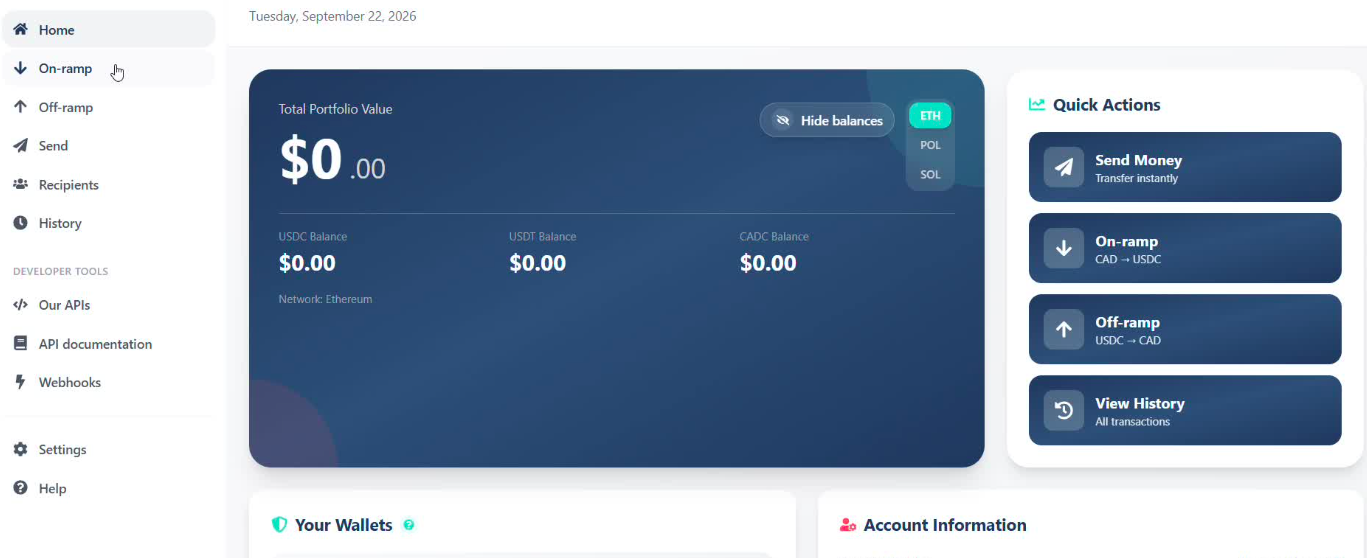
Figure 1: The Kavodax dashboard — customer wallet balances (USDC, USDT, CAGD) and orchestration actions (Send, On-ramp, Off-ramp) that the Open Payments layer will sit on top of.
How We Plan to Use Open Payments
Kavodax operates as an orchestration layer: our own APIs sit at the center, coordinating everything from account balances and wallet infrastructure to banking rails and settlement partners across the corridors we serve. Open Payments will sit above that orchestration layer as a standard interface, not a replacement for it. It handles how a sender and Kavodax find each other, agree on the terms of a payment, and communicate intent — using wallet addresses, quotes, and incoming/outgoing payment resources. Our existing APIs and transaction engine still handle the actual movement and safekeeping of funds, working alongside our banking partners and wallet infrastructure. The goal is for Open Payments to become the common language external partners can use to reach Kavodax's orchestration layer, instead of each one requiring its own custom connection.
What We're Already Building
Kavodax isn't starting from zero. We're already live across 70+ countries, with a working dashboard and public APIs powering on-ramp and off-ramp flows. Customers hold balances in stablecoins like USDC and USDT, alongside CAGD (CAD Global Dollars) — our own CAD-backed stablecoin — and can already move funds in and out of those balances in a live sandbox environment.
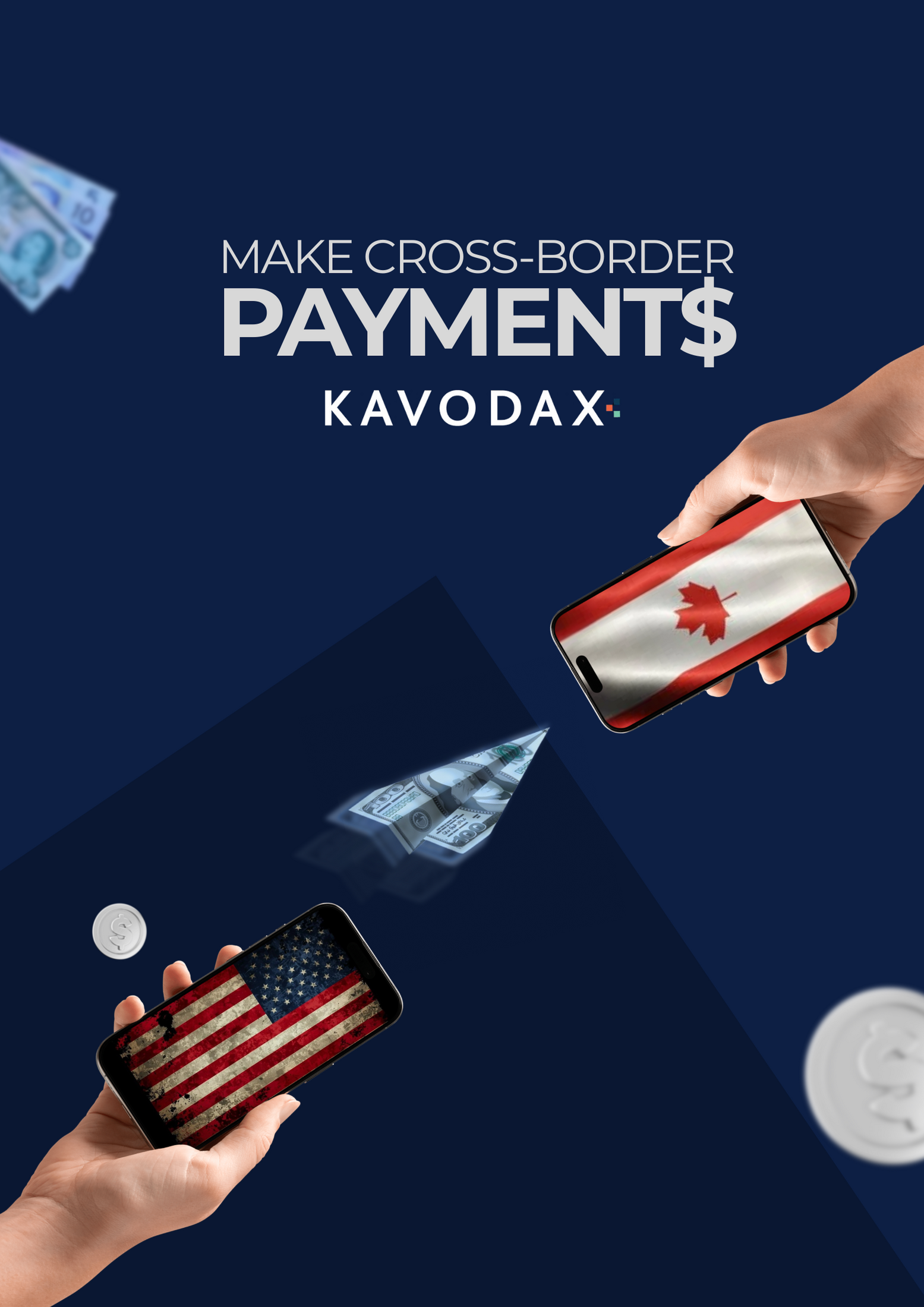
Figure 2: Kavodax's off-ramp corridors each connecting stablecoin balances to local payout rails.
What's still ahead, and what this Accelerator is specifically for, is the interoperability layer on top of our orchestration APIs: standards-level Open Payments support (rather than only internal, Kavodax-to-Kavodax flows), the authorization flow required for a truly independent participant to connect (GNAP-based grant negotiation and HTTP message signing), and validating all of this against an outside Open Payments implementation rather than just our own systems talking to themselves.
What We Hope to Demonstrate
By the end of the Accelerator, we want to show that an independent Open Payments participant — with no prior relationship to Kavodax — can resolve a Kavodax wallet address, complete the full payment flow, and have funds settle through our existing orchestration infrastructure. Success looks like:
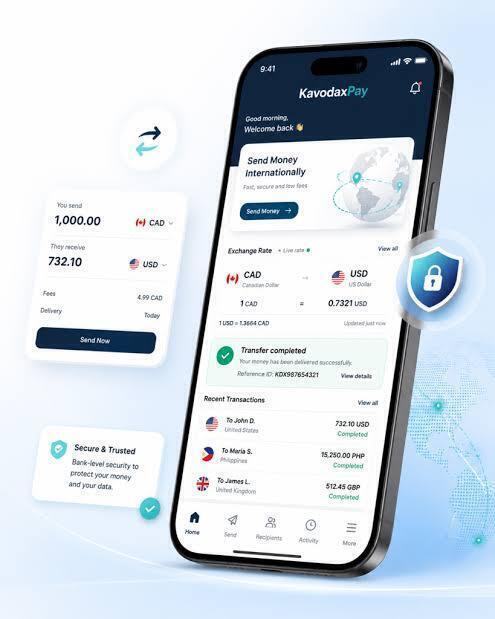
- A working payment completed end-to-end by an outside party with no custom integration.
- The required authorization steps (including secure message signing) functioning correctly between two independent systems.
- Transaction events properly recorded and monitored under our existing compliance controls.
Looking Beyond the Accelerator
If successful, this proof of concept becomes the foundation for onboarding real partner platforms across the 70+ countries and corridors we already serve — without the months of custom integration work that would otherwise be required. It also lays the groundwork for expanding CAGD and our orchestration APIs into new settlement corridors, and bringing more financial service providers into a shared, interoperable network built on top of the infrastructure we've already deployed.
What We're Excited to Learn
We're eager to see how Open Payments performs when a truly independent counterpart — not just our own systems talking to themselves — interacts with Kavodax's orchestration layer in practice. We also want to learn what parts of the onboarding and authorization process create friction for outside developers, so we can share that back with the wider Interledger community.
About Kavodax
Kavodax Inc. is a registered Money Services Business (FINTRAC) and licensed Payment Service Provider with the Bank of Canada, operating as an orchestration layer for faster, more affordable cross-border payments. We're live across 70+ countries, with public APIs powering customer wallets, stablecoin balances — including CAGD, our own CAD-backed stablecoin — and live on/off-ramp corridors. We're grateful to the Interledger Foundation for the opportunity to test whether open standards can make that experience faster and fairer for everyone who connects to our network.
Kavodax Email address: contact@kavodax.com
Linkedin Profile: https://www.linkedin.com/in/gharsanay-amin/
https://www.linkedin.com/company/kavodax/?viewAsMember=true
https://x.com/Kavodax


Top comments (0)