

Between 2020 and 2022, I had the privilege of being selected as a recipient of the Interledger Foundation’s Grant for the Web initiative.
During that period, I conducted extensive research exploring how Open Payments and Web Monetization could be introduced to communities that have historically been underserved by both traditional finance and emerging technology.
What fascinated me wasn’t simply the technology itself.
As a storyteller, for me, it was the human challenge of answering:
How do you help people understand something entirely new?
How do you create trust?
How do you build bridges between a powerful technology and the communities that stand to benefit most from it?
At the same time, I experienced many of the frustrations shared by others in the ecosystem:
The onboarding wasn’t always easy.
The user experience wasn’t always intuitive.
The infrastructure was still evolving.
Like many early advocates, I saw both the potential and the gaps, but rather than discouraging me, those frustrations sparked my imagination because the storyteller in me wants to know how this Open Payments story ends!
The Proof of Inevitability
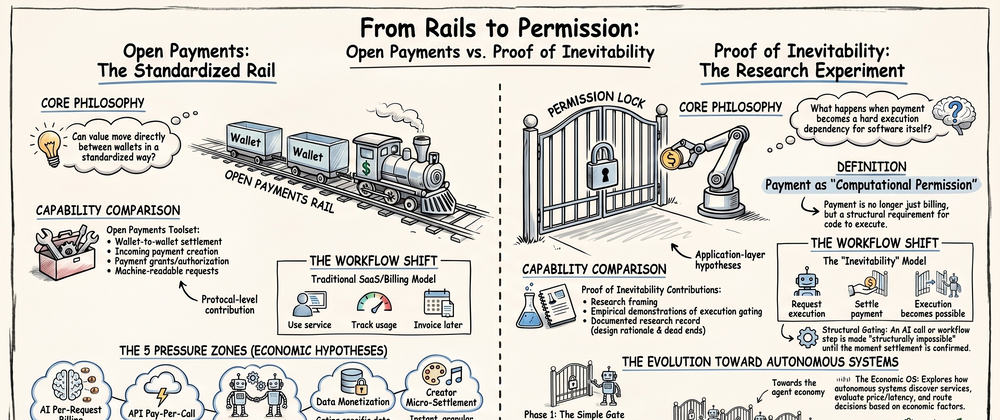
Open Payments provides the rail. Proof of Inevitability provides the experiment.
Earlier this year, I submitted a fellowship proposal to the Interledger Foundation, built around a research initiative called Proof of Inevitability.
The central question is simple:
"What happens when we stop talking about Open Payments as a future possibility and start demonstrating practical, real-world scenarios where its adoption becomes the obvious outcome?"
While working on subscription packages for my wellness company MICOPEIA Botanica (MicopeiaBotanica.com), I started questioning the entire subscription model. I was genuinely frustrated with the costs of both third-party apps that I had to utilize on top of my Shopify subscription itself, in order to have subscription-related checkout options available for my customers. Then, I am losing money once payment is made through fees and base costs of using Stripe, PayPal, etc.
I began asking myself, “How and WHY am I/we STILL going through this friction for access?” The fact is, if I were standing at the front door of my storefront and/or a nightclub and charged an entry/door fee for access, as long as the person/customer in line has the money and pays, they are allowed inside.
That’s when I suddenly was able to add a new sentence and chapter to this ongoing Open Payments story that I have been so invested in.
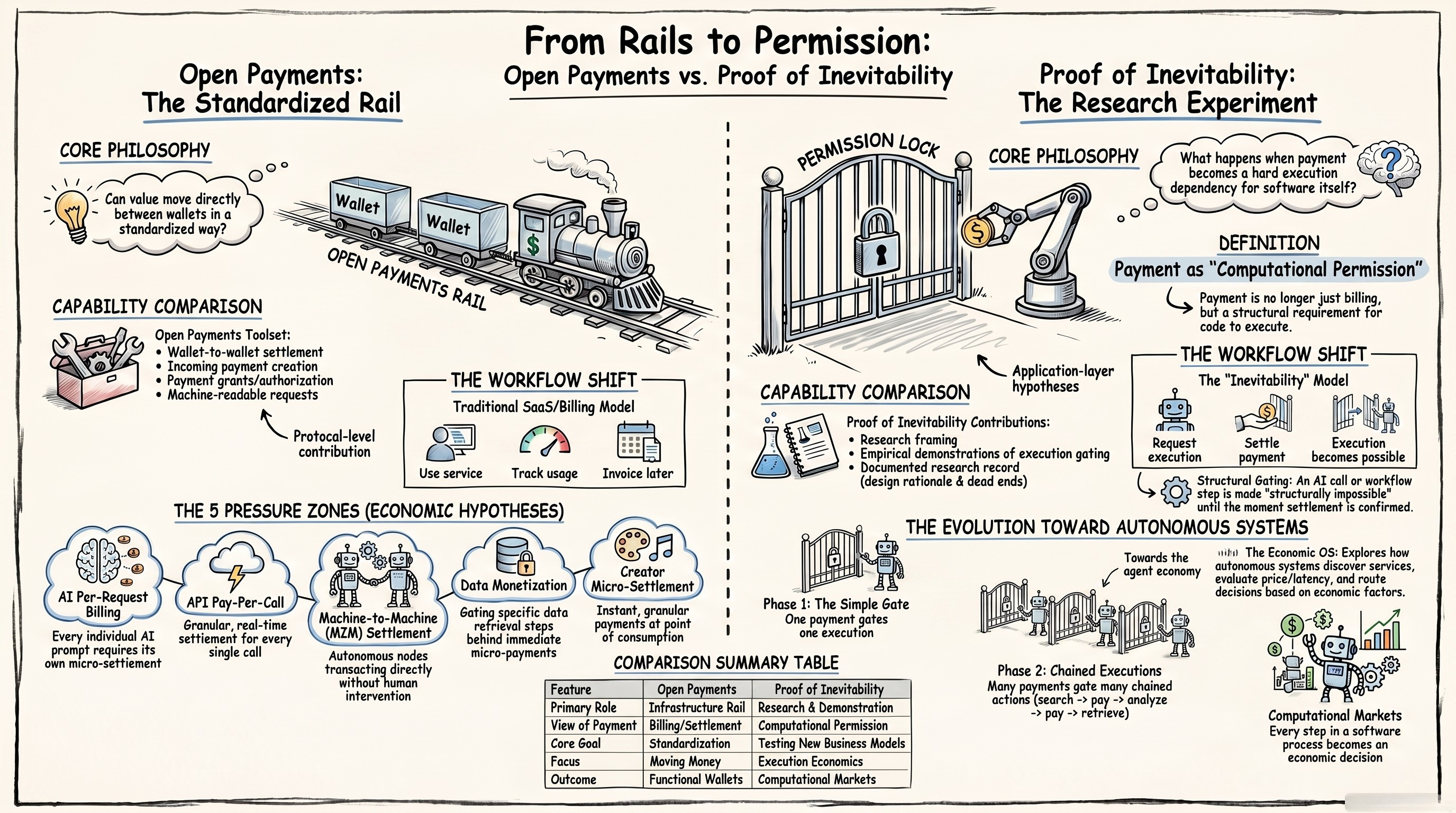
The sentence was/is: What happens when the payment itself becomes the permission to execute an action?!
I knew that Open Payments answered:
“Can value move directly between wallets in a standardized way?”
…but now, under the lens of payment as permission…I started seeing the ways in which traditional rails simply CANNOT confidently stand as universal gates in several instances. I jotted them down and these became the pressure points in which I focused on:
AI per-request billing
API pay-per-call
Data monetization
Machine-to-machine settlement
Creator micro-settlement
You see, Open Payments already contains the ingredients:
- Wallet-to-wallet settlement
- Incoming payment creation
- Payment grants and authorization
- Machine-readable payment requests
- The ability to gate access to a resource
…but now, what happens when payment isn’t thought of as billing but as permission.
When this happens…like the snap of Thanos’s fingers, Open Payments suddenly becomes INEVITABLE!
That subtle shift changes the design space completely.
Instead of:
Use service
↓
Track usage
↓
Invoice later
You get:
Request execution
↓
Settle payment
↓
Execution becomes possible
So the Proof of Inevitability becomes a real artifact demonstrating that:
- an AI call
- an API call
- a workflow step
- a machine action
can be structurally impossible until settlement occurs.
That’s the “proof” in Proof of Inevitability, and this research project is testing whether Open Payments can be seen and utilized for more, by potentially unlocking entirely different business models.
All that being said, my original plan was straightforward: Submit my ongoing research as a fellowship proposal to ILF, but not before completing at least Phase 1 of the research first!
It was important to me to return to actively contributing to the Open Payments ecosystem with more than just a concept and hypothesis. I felt an ardent duty to prove to myself FIRST that what I was seeing and writing as a potential next chapter in the Open Payments story was even possible.
…and it WAS!
So I applied to the fellowship back in April 2026, and I was/am super proud of myself! This journey has also given me the great joy of publishing my first GitHub repo! Check it out here: https://github.com/rashonmassey/proof-of-inevitability. At that point in the submission period, I decided to keep the repo private, just to make sure it stayed protected until the grant reviewing team had a chance to see it first.
I genuinely was so at ease about the fellowship submission that I thought I was just going to be able to wait patiently for feedback, before continuing into Phase 2.
That is not whats happened.
Whats actually happened is that I’ve become too excited to wait! Honestly, anyone in this community who knows me just knows that's how my energy is. When I am passionate and excited about something, I show up and give my ALL!
So naturally, after finishing Phase 1 and proving to my own self that I can both do this and that the story I'm writing is very much aligned with what is happening in the world, ....I...ummm.... started funding the research myself.
The idea of waiting patiently until summer or fall to keep at it just didn't sit well with me. This research feels important and opens up conversations, code and pathways forward for Open Payments into territories in which traditional rails just can't compete.
Also, since this is public research, the code is released under the MIT License and the documentation found in the repo's /docs is released under CC BY 4.0.
So for a quick overview of what I have done (full Phase Case Studies available at the repo - https://github.com/rashonmassey/proof-of-inevitability
Phase 1: Payment as Permission
The first phase asked a deceptively simple question.
Can payment become a prerequisite for action?
Not billing after the fact.
Not subscriptions.
Not invoices.
Can software literally refuse to proceed until payment is confirmed?
The answer turned out to be yes!
Phase 1 successfully demonstrated a real Open Payments settlement gating a real software execution. Payment became permission.
Not theory. Not a mockup.
A working implementation with receipts.
For me, this was the moment the research stopped being an idea and became evidence.
Phase 2: Agents, Automation, and Scale
Phase 2 expanded the question dramatically.
Could an autonomous agent perform multiple tasks where each step required its own independently verified Open Payments settlement?
Again, the answer was yes.
Performance testing, multi-step agent workflows, payment-gated execution chains, visualization tools, settlement metrics, and operational viability testing all advanced well ahead of the original roadmap.
Phase 1 proved: one payment can gate one execution.
Useful, but expected.
Phase 2 moved toward: many payments can gate many chained executions.
Phase 2 brings us much closer to my Open Payments agent economy thesis.
An agent that performs:
search
↓
pay
↓
analyze
↓
pay
↓
retrieve data
↓
pay
↓
generate report
is fundamentally different from: monthly SaaS subscription
This is significant because the moment every step can become an economic decision, you’re no longer doing billing. You’re doing computational markets, and this is exactly where the research begins to extend beyond the basic Open Payments usage that we’ve all known up until now.
What was originally scheduled months into the future (starting Phase 2) became something I was actively demonstrating, just under two months following the completion of Phase 1.
The most important finding was surprisingly simple: The payment rail was the bottleneck and not the software, as the software performed with negligible overhead.
The implication is profound.
As I am seeing, as the overall payment infrastructure improves, the practical viability of payment-gated automation improves with it.
What’s Coming Next
The roadmap continues.
Future phases will explore dynamic routing between providers, creator-focused micro-settlement systems, live merchant integrations, visualization layers, and open research documentation designed to help the broader Open Payments ecosystem learn from both successes and failures.
It is exciting to return to working with Open Payments with a fresh perspective, enthusiasm and a roadmap that's allowing me to explore where these potential narratives can take it. I truly believe that when we can build the tech and make them understandable, it is so much easier to help communities see themselves inside the very future being built around them, while inspiring and encouraging them to join in and participate with it's active ongoing development.



Top comments (0)