

Project Description
The Alliance of Digital Finance and Fintech Associations (AllianceDFA), in partnership with Contigo Global LLC, was awarded a public policy activation grant from the Interledger Foundation (ILF) to lead a new global initiative aimed at making Instant Payment Systems (IPS) more inclusive and accessible to fintechs, and non-banks. The project‘s focus is to identify and document the challenges and successes that fintechs and other non-banks are experiencing in their markets, and will explore ways to strengthen the voice of inclusive finance actors in IPS governance, while identifying solutions to overcome the barriers that limit their integration and impact.
The interim progress report is available here: https://community.interledger.org/sarah_747/midterm-report-making-ips-more-inclusive-and-accessible-to-fintechs-and-non-banks-assessment-2p5k
Project Update
The project progressed very well overall, although the timeline was extended by one month due to four key factors:
Availability of fintech associations and focus group participants: We learned that January is a particularly slow period for engagement, especially across Asia and Latin America. Securing focus group dates required persistence, leveraging personal relationships, and dedicated outreach, but ultimately we successfully conducted 17 of the planned 18 focus groups and engaged five associations across Latin America and the Caribbean. The focus groups brought together participants from countries across three continents, Latin America and the Caribbean, Africa, and Asia, representing a diverse range of contexts, from small to large economies and populations, and from emerging to more established IPS ecosystems.
The volume and quality of insights generated: The focus groups produced exceptionally rich and detailed insights. As a result, the time required to process, categorise, analyse, and write up the findings was greater than originally anticipated, and the final assessment was approximately double the length initially planned. We also captured many powerful participant quotes, which we felt were important to include to ensure authentic voices were reflected throughout the assessment and to strengthen its overall impact.We believed the additional time and expanded length were warranted given the consistency of findings emerging across regions and stakeholder groups, as well as the value of documenting the depth and nuance of participant experiences and perspectives.
The intentional design of the methodology and focus groups: The methodology and focus group design were highly deliberate and proved to be very effective. Given the strength of the engagement and resulting discussions, we also included an additional section outlining what we identified as the five key factors that contributed to generating such high-quality insights. This section was titled Five Design Principles for Inclusive Private Sector Engagement.
Decision to peer review before publishing: To further strengthen the quality and credibility of the assessment, two external peer reviews were conducted at different stages of the process. A detailed technical review was undertaken by Arunjay Katakam, whose feedback informed a series of refinements to the structure, framing, and articulation of the findings. Following these revisions, a second high-level review was conducted by David Porteous to provide an additional perspective on the overall coherence and positioning of the assessment.
The peer review process helped validate that the findings were well connected, clearly explained, and supported by a coherent methodology and narrative flow. Feedback from reviewers reinforced the strength of the assessment and the relevance of its core themes. David described the assessment as “clear and compelling”, while Arunjay highlighted in particular the way the research “surfaced the tension between acquisition-phase incentives and long-term sustainability of IPS” and noted that “reframing governance as a determinant of accessibility rather than merely an administrative function is an important point.”
The assessment has been published and is available here: https://alliancedfa.org/2026/05/19/questioning-ips-design-inclusivity-unlocking-fintech-and-non-bank-participation-in-domestic-instant-payment-systems/
The assessment's value has been further validated through its acceptance by FinDev Gateway as a resource in their online knowledge bank, broadening its visibility among global financial inclusion practitioners https://www.findevgateway.org/paper/2026/05/questioning-ips-design-inclusivity-unlocking-fintech-and-non-bank-participation-in
*Project Impact & Target Audience(s) *
The research surfaced perspectives that have not been captured in discussions on IPS. In selecting markets and participants, deliberate effort was made to engage a broad mix of countries and to ensure representation from smaller fintechs, non-bank providers, and early-stage firms, and countries researchers often overlook. These actors are less visible in policy and industry dialogue, despite operating closest to underserved customer segments and being highly affected by infrastructure, access, and regulatory decisions. Their contributions added important practical insight into how IPS design and governance decisions can influence innovation, competition, and the ability to reach financially excluded groups.
The project also demonstrated strong engagement among ecosystem stakeholders. Participating associations highlighted the usefulness of the findings for informing advocacy priorities, member engagement, and dialogue with regulators and IPS operators. Across regions, there was clear interest not only in the final findings themselves, but also in opportunities to better understand how similar challenges are being approached in other markets.
This created momentum beyond the research process alone. The assessment and planned dissemination activities (including webinars and local events) are therefore intended to support ongoing peer learning and collaboration between associations and ecosystem actors, while helping translate shared experiences into stronger advocacy, programme design, and policy engagement.
Within the findings section of the assessment, attention is also given to the potential implications of identified barriers for underserved consumer groups. Each section includes an Impact on Marginalised Communities component, exploring how the findings may affect groups such as women, rural populations, and people with disabilities. These reflections draw on existing research and, where relevant, insights shared by contributors. They are intended to provide contextual interpretation of the possible downstream effects of the identified barriers and enablers, rather than present primary findings generated directly through this assessment.
Progress on Objectives
Supporting membership deepening within AllianceDFA, particularly in Latin America and the Caribbean.
Deliverable met with the onboarding of FinteChile. In addition, Miami Fintech Club is being onboarded in May 2026, which has members from the US, Caribbean and Latin America, which will support our reach in the region.Produce a published Assessment on the Deeper Needs & Challenges of FinTechs in Integrating into their local IPS.
Deliverable met, the assessment has been published: https://alliancedfa.org/2026/05/19/questioning-ips-design-inclusivity-unlocking-fintech-and-non-bank-participation-in-domestic-instant-payment-systems/Internal Assessment: An Internal Set of Recommendations on What Deeper Solutions Could Serve the Global FinTech Ecosystem to Increase Inclusive Governance.
Deliverable met, the assessment has been submitted to and received by the Interledger Foundation.
Communications and Marketing
The report's launch was marked by a coordinated global outreach effort: six local events and one global webinar delivered across a 10-day period in June 2026. Each local event was led by the respective association partner engaged in the IPS assessment, spanning six markets, Cameroon, Chile, Kenya, Nepal, Nigeria, and Tanzania, and convening approximately 60 participants in total. A seventh event, in the Caribbean, is scheduled for July, following the launch of BimaPay, the region's own IPS, in Barbados.
These local events were designed to sustain the momentum of the original research, creating a direct feedback loop with the focus groups that shaped the assessment. Findings were debated in-market, priority areas for continued advocacy were identified, and association partners will carry the advocacy forward, with AllianceDFA's ongoing support.
These events culminated in a global webinar on 18 June, with the following speakers :
- Ayden Ferdeline – Interledger Foundation
- Jacqueline Jumah - AfricaNenda
- Holti Banka - World Bank
- Selassie Tay, CEO - Accelerex (Ghana)
- Constanza Munoz Torrez, Chief Legal Officer - ProntoPaga (Chile)
- Arianne Ferrer, Director of External Affairs - Tala (Philippines)
- Danielle Lawrence, COO at FINASA (South Africa)
- Nandini Harihareswara, Director, Contigo Global
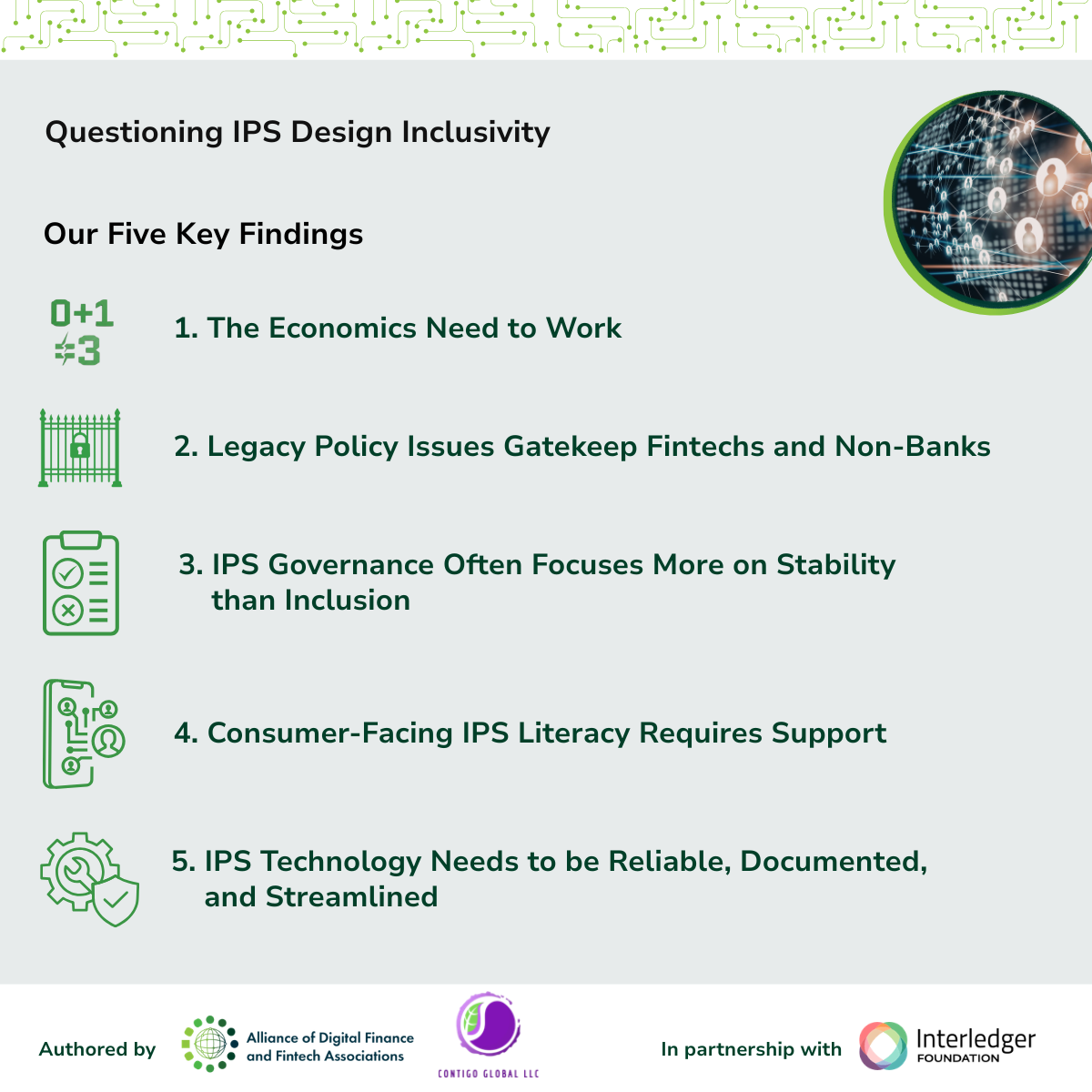
The session opened with Sarah and Nandini presenting the assessment's methodology, the role of associations in the research, and its five key findings. This was followed by a panel of four fintech representatives, who grounded the findings in lived market experience, offering candid, practical examples of the barriers and enablers shaping fintech participation in IPS across their respective regions.
The webinar closed with panel, moderated by Nandini, drawing together global perspectives on the Inclusive IPS agenda. Holti Banka of the World Bank spoke to the critical role fintechs play in advancing inclusive payment infrastructure, a view reinforced by a statement from AfricaNenda, delivered in writing after Jacqueline was unable to join in person due to illness. The session closed on a clear, unifying message: for instant payment systems to genuinely serve new and underserved consumers, IPS design must move beyond incumbents to actively accommodate fintechs and non-banks, and enable them to build new products and services on the rails.
The webinar itself underscored the scale of global interest in this agenda: 303 registrations and 117 unique participants (39% attendance rate), drawn from 57 countries, a footprint that speaks to the breadth of the assessment's international relevance.
In addition, opportunities will be explored to present the findings through conferences and webinars hosted by partner and peer organisations, as well as through collaborative dissemination activities such as blogs, articles, and podcasts. This will include collaboration with organisations such as Interledger Foundation to help broaden the reach and visibility of the work.
What’s Next?
 Following dissemination of the findings, we plan to assess which themes resonate most strongly with stakeholders, where there is greatest appetite for further engagement, and which issues partners, including central banks, IPS operators, and ecosystem actors, may be most interested in advancing. These insights, alongside recommendations provided to Interledger Foundation, will help inform opportunities for future collaboration, funding, and follow-on activities aimed at strengthening the inclusivity of IPS for fintechs and non-bank providers.



Top comments (0)