

Brief Project Description
At the Financial Innovation Hub. our focus is on providing world-class education in financial technology to students at the University of Cape Town. Through our partnership with Interledger, we are developing and implementing an open payments curriculum for students. Outside of UCT, we are also working to expand Interledger's reach among students in South Africa and at other universities through workshops, bootcamps, and hackathons. You can find our initial progress report, here.
Project Update
MPhil Class of 2025 and Scholarships
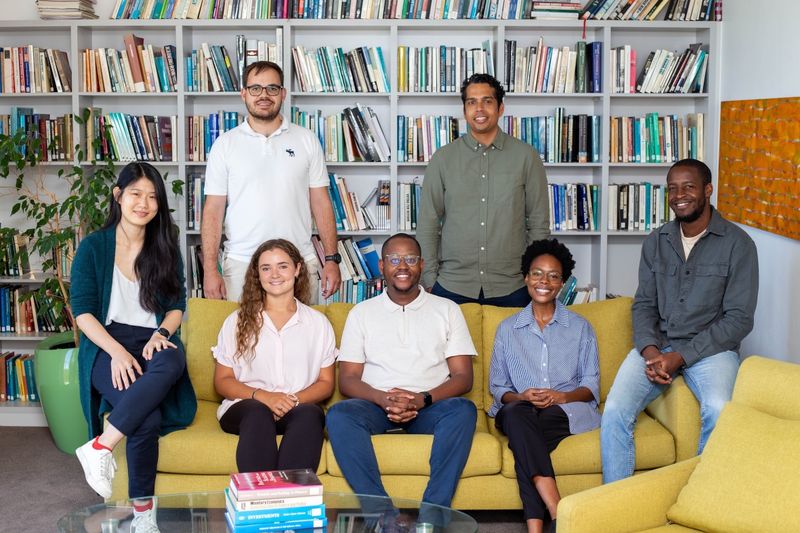
We concluded another successful year for our MPhil class. We had a really vibrant class this year and many standout moments. My favourite one involves the class project that our 2025 class took on, developing a solution called Nkadime, a decentralised micro-lending platform leveraging Open Banking APIs, alternative credit scoring, and XRPL smart contracts. Here I am with the class of 2025.
With the support of Interledger we were able to provide scholarships to 7 students this year! Here are some of our bursary recipients talking about their future aspirations.
Open Payments Workshop and Hackathon
This year, we ran our second iteration of the UCT / Interledger Open Payments Bootcamp and Hackathon, where we introduce students to Open Payments over 5 days during the mid-year break and challenge them to develop a fully functional application at a full-day hackathon. This year’s iteration had many highlights, including
- Increasing the number of students who attended from 40 to 70
- Increasing representation of students to having students from 4 different universities attending
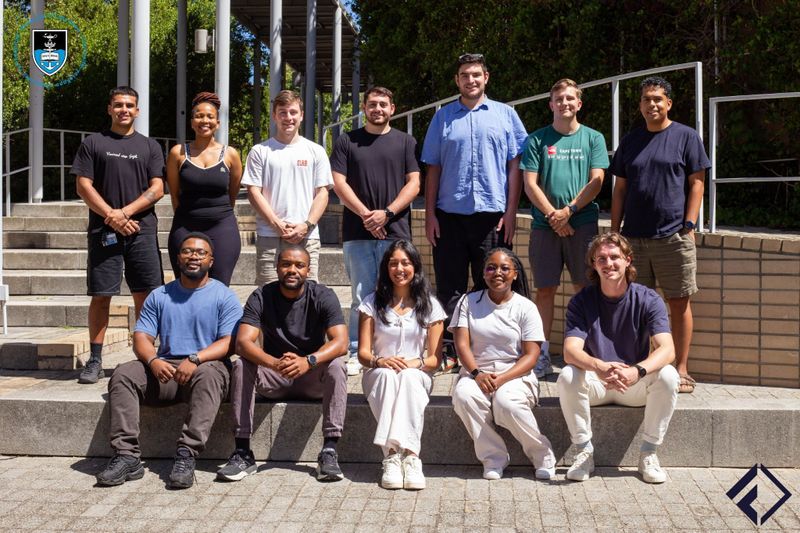
Here is a post-hackathon photo with everyone.

This hackathon is a formative moment for the students, as it represents the first experience of a hackathon for most attendees. This year’s winning solution, Direla, used open payments to turn smartphones into a POS terminal, allowing merchants to accept payments via NFC, QR codes, and WhatsApp aliases. Dylan, a member of Direla and Interledger Bursary Recipient, did a blog post on the forum about his experience. Here is also a photo of the winning team with Raul and I.

If you haven't seen it already, here is a great short video about the 2025 Hackathon.
Women in Tech Campaign
We all know that the financial services and technology sectors have historically been under-representative of women. As a result, empowering women to be successful in the FinTech space is something very important to us. Under the guidance of Lindi, our Hub Manager, this year, we wanted to showcase and tell the stories of women doing amazing things in Tech. This led to the “Women Stories in Tech” campaign we ran around Women’s Day. In this series, we featured seven interviews with inspiring women working in tech. We ran the campaign on LinkedIn, and the interviews are available on our YouTube channel, here. We kicked off the campaign speaking to the ILF's own Matseliso Thabane!
Practitioner seminars
An important part of our degree programme are our practitioner seminars, where we invite people doing amazing things in the FinTech space to give a talk to our students telling them about their work and sharing their experiences and life lessons from working in the space. These sessions are tremendously insightfull for our students and help to connect them to what is happening in the FinTech space. This year we were delighted to host 10 practitioner seminars, roughly one a month for the academic calendar. Some of our notable speakers included: Brenton Naicker, Principal & Head of Growth at CVVC, Mark McChlery, Co-founder and Chief Data & Analytics Officer at PayJustNow, the largest Buy-Now-Pay-Later (BNPL) company in South Africa and Thomas Brennan: CEO & Co-founder at Franc (who won SA FinTec of the Year at the recent SA FinTech awards), a savings and investment app, aimed at increasing financial inclusion through reducing the barriers to saving and investment. Here is Brenton delivering his practitioner seminar.

Some areas where we fell short and lessons learned
Despite these success, we also had some goals we didn't achieve and learnt some important lessons in the process.
The major being the fact that we wanted to be successful in putting out more academic research on payments. To enable this, we hired a research fellow, but she could only work on a part-time basis and that slowed us down a bit. That being said, we did manage to produce one paper exploring the current payment system reforms in South Africa and it's implications for financial inclusion.
Another important lesson for us what that as your ambitions grow, so should your team. We are a lean team, currently with only 5 members. We felt that this year given the increasing scope of our work and started to hit a resource constraint relative to our time vs our ambitions. We'll be growing the team next year to help us scale!
Project Impact & Target Audience(s)
Scholarships
Darryl Nyamayaro and Siphiwe Bogatsu, both Interledger scholarship recipients in 2024, have been making waves with their startup iDini, a platform which helps people manage their insurance policies. This is an important use case in South Africa where the average household has three to five policies and where the policy lapse rate is 55%. This means that for many people, a single missed payment renders their policy null and void. iDini helps people manage their policies and keep their insurance.
Hackathons and student innovation
Continuing with Darryl and Siphiwe's story, not only were both of them Interledger scholarship recipients, but they also won the 2024 UCT/Interledger Hackathon for iDini. Here is a photo of Siphiwe, Darryl and the rest of the iDini team from our most recent student start-up pitch night.

We've seen a similar success story in 2025. The 2025 winning team (containing two Interledger scholarship recipients) have continued to develop their hackathon-winning idea, Direla, and have gone on to recently take 2nd place at the Africa Tech Week MCP Hackathon. They are now in the early fundraising phase as they look to develop a full MVP.
Many of the other Interledger scholarship recipient for 2025 have also been pursuing start-up ventures. Keba and Victor, are developing ProcureLink, a blockchain procurement system that ensures tamper-proof records, transparent bidding, and automated contract management and Marc is developing CaseCleared,a legal finance platform that tokenizes pending invoices and settlements, giving law firms and expert witnesses faster access to cash. Here is a photo of Keba and Victor from our most recent pitch-night ...

... and another of Marc, pitching CaseCleared to the audience.

Arguably, the biggest success we've had comes from Gregory Andrews, another one of our students, who has had tremendous success with his start-up, Tata iMali, which provides low-cost point of sale (POS) machines to vendors. Tata iMali was named of one of the FinTech Startups to watch in South Africa by TechCabal and Greg successfully raised seed funding from no other than Interledger's own Stefan Thomas as an angel investor.
These stories highlight the vibrancy of innovation at the Hub, the critical role of the hackathon as the idea bed for many startups,, and the quality of these ideas, despite the young age of the founders, all of whom are students. Most importantly, all of this would not be possible without the Interledger scholarships for our students, many of whom would otherwise not be able to afford the costs of tuition.
We look forward to building on this success into 2026!
Representation in our degree
We've always taken pride in the extent of representation in our students, with 51% of the students we've so far admitted into the degree across the 8 years of its inception being women, an especially marginalized group in the FinTech. Despite our best efforts, the share of women in our degree fell to less than 25% last year.
To address this, we did several things, most notably
- Sponsoring and working closely with the Women in Computer Science (WiCS) student society at UCT to increase our visibility with women on campus
- Undertook a Women in Tech campaign (details in the previous section)
Given these efforts, I'm proud to say that we've more than double the representation of women in our class of 2026, with women making up 50% of the cohort!
Recognition for our work
In November, we had the great honour of winning an award for Enchancing Financial Inclusion for the Hub's work in conjunction with the ILF. This award affirms the vital role universities play in advancing inclusive financial innovation through nurturing and empowering young people to build the technologies that will power the financial system of the future: one that is open, inclusive and shaped by the needs of the communities it serves.
Here is a photo of Lindi receiving the award on stage ...
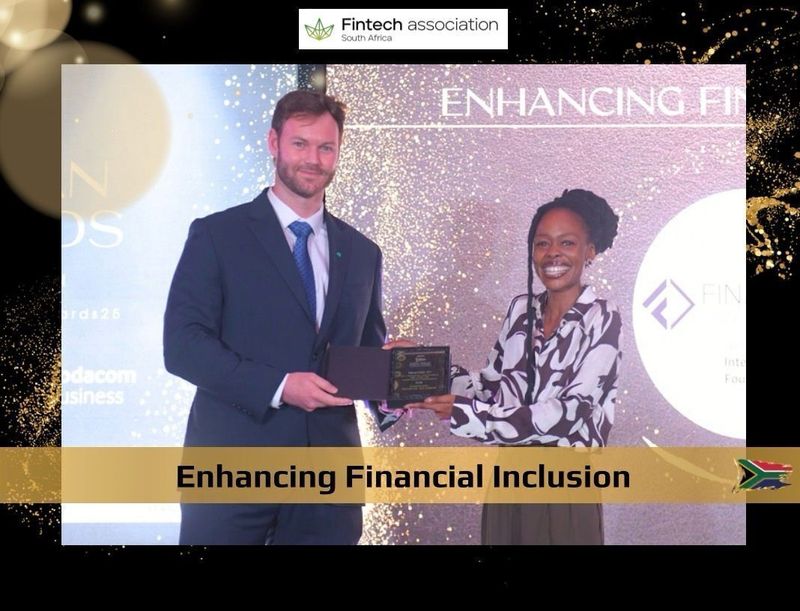
... and another of Lindi and Greg (who was also at the awards, having been a nominee in a different category himself - once again showcasing the talent of our students!)

Communications and Marketing
We’ve been fortunate to have had a lot of media coverage highlighting the work we’ve been doing at the Hub.
This year, our hackathon received a lot of attention, including coverage on MSN South Africa BizCommunity, FinTech News Africa, ITWeb, Lifestyle and Tech, Silicon Africa and Connecting Africa. Media analytics provided to us from a marketing firm told us that the combined media following our hackathon reached a staggering 545,000 people!
We also did a lot of work to create more awareness about the NextGen Education Grant among South African universities. One example of this was an interview that Lindi did on ENCA, one of the largest news channels in South Africa. You can watch that here. We believe these efforts will see more South African universities become part of the ILF ecosystem going forward.
Our students have also been in the news. Greg, who I mentioned earlier, has been making waves with his start-up, Tata iMali, and profiled in an article by UCT, and Tata iMali was named one of the FinTech Startups to watch in South Africa by TechCabal.
Darryl and Siphiwe have been highlighted by UCT for placing 7th (out of 200 student startups!) in the 2025 Entrepreneurship Development in Higher Education (EDHE) Entrepreneurship Intervarsity Competition!
Finally, UCT also did two features on us this year,one highlighting a pitch night we held for all of the student startups we are currently working to incubate at the Hub and another more recent one profiling our successes this year.
What’s Next?
Extended Hackathon reach
The hackathon has quickly become one of our flagship initiatives with the Interledger Foundation, attracting over 110 student participants across its first two years. In 2025, we took the vital step of inviting students from other Western Cape universities, which significantly enriched the diversity of perspectives and ideas. In 2026, we will extend this momentum nationally by making the hackathon accessible to students from disadvantaged regions across South Africa.
New coursework
Given the rapid rate at which technology is evolving, we will starting an extensive refresh of our academic programme over the next two years. Next year, we'll re-fresh one of our course Digital Economics. The revised course will be structured around four broad themes: digital payments and interoperability, digital platforms and market structures, financial products, and artificial intelligence.
By approaching digital payments, platforms, financial products, and AI through the lens of developing country realities, the course ensures that issues of equity and inclusion are placed at the centre of analysis. Over the coming years, this course will expose hundreds of UCT students to these debates, helping to build a pipeline of graduates able to engage critically with the design of digital financial systems in South Africa and beyond. A one-page brief outlining the structure of the course is included as an annexure.
Innovation that builds on Open Payments
Several promising Interledger-based ideas emerged from the 2024 and 2025 student hackathons. These ideas, however, did not progress beyond the hackathon, mainly due to the lack of structured support and encouragement.
Conversely, the Hub runs a successful nine-month pre-incubator programme, where we assist aspiring student entrepreneurs in developing their start-ups. Our start-ups have been highly successful in fundraising, having raised $1.48 million so far.
Going forward, we want to work to combine these two worlds. We will work to incubate a start-up building on Interledger, ideally one from the hackathon itself, each year, and provide them with the business development and technical support (from our technical specialists) to grow their idea. The goal being to create a pipeline of student start-ups building on Interledger, who in the future would be eligible to apply for the digital financial services grants.



Top comments (2)
Incredible report, @allan!
Really excited about the progress this initiative has made.
Great report!