

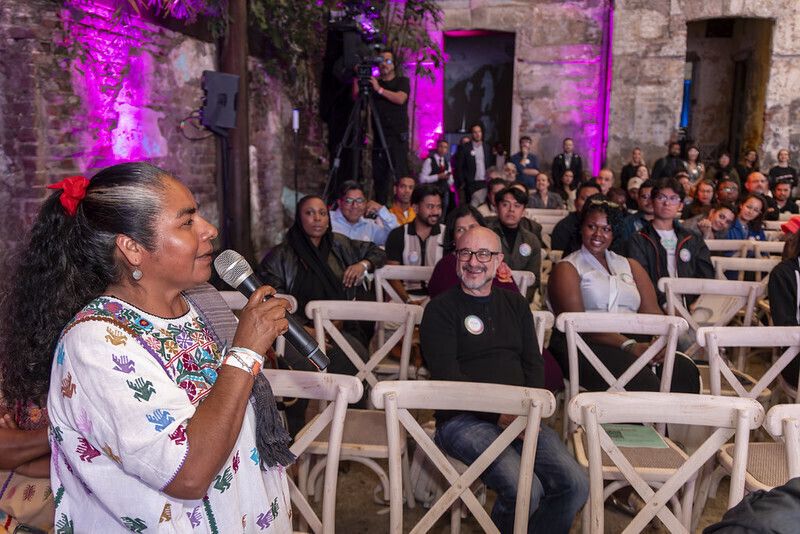
The Community showcase and ILF Summit
The work of AMUCSS (Asociación Mexicana de Uniones de Crédito del Sector Social), the People’s Clearinghouse, and the Interledger Foundation is rooted in one shared belief: that financial inclusion is not just about money, but about people, land, and culture. What might seem like simple economic activity is, in truth, a story of life, resilience, and tradition. One where digital tools meet ancestral knowledge to build a fairer future. This project had the goal of integrating rural reality and technology in the most humane way possible.
Project development
The Community showcase along with the progress made by The People’s Clearing House in the development of the necessary technology to achieve financial inclusion in rural areas merged into a display of how integration is possible and necessary in Mexico.
Project Impact & Target Audience(s)
The communities we serve are shaped by the milpa - the traditional system of intercropping - which is the spiritual foundation of everything we do in Mexico. This is in turn reflected in the floral patterns woven into each piece of fabric, in the pollination of squash flowers by bees, in the historic cultivation of the Three Sisters (corn, beans, and squash), and in our ancient gastronomic culture. Everything is part of an ecosystem that must be maintained and carefully preserved. It is this deep awareness that has allowed Arabica coffee to grow sustainably under shade and achieve high quality standards.
Key Activities and message at ILF Summit
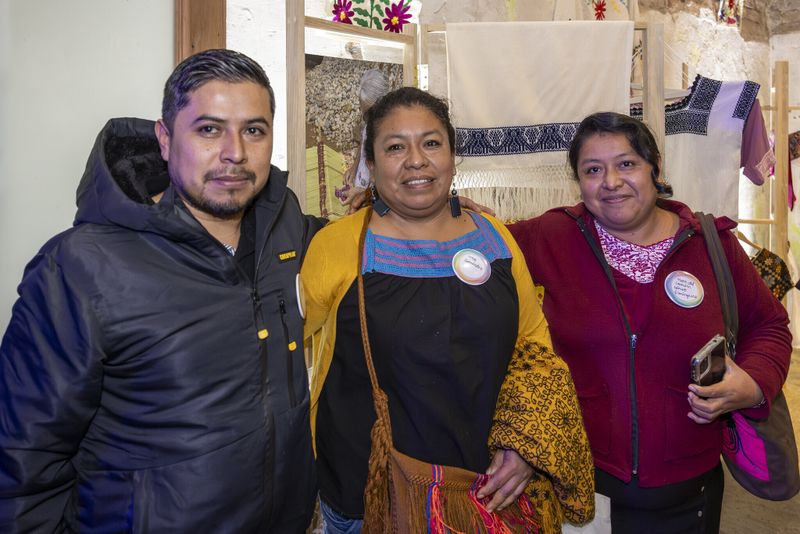
Behind banking technology are people who need financial services: people with families marked by a history of migration to the United States who now send remittances, and people who need access to true financial inclusion. This effort is for them, and with the community showcase at ILF Summit they showed what the modern banking system has forgotten: behind every transaction, there is a human being. Each handcrafted piece, every pound of coffee, every story shared at this fair represented the same idea: technology can be a tool for economic justice when it serves communities.
The People’s Clearinghouse was created as a bridge between microbanks (promoted by AMUCSS), cooperatives, and the digital financial system. Together with the Interledger Foundation, it promotes a model in which interoperability and open source become vehicles for economic sovereignty.
At this ILF summit, AMUCSS and The People’s Clearinghouse presented a goal: A network where rural microbanks connect to the world without losing their identity, where the digital economy becomes humane, and where every transaction carries with it dignity, community, and memory. The message of this showcase was that technology only makes sense when it grows from the ground up, when it serves to unite, not to exclude, when it transforms without erasing who we are.
The showcase: Four areas of tradition, one technology to bond
During the showcase producers tested a new technology that will bring financial inclusion closer to them: The reality of digital technology intertwined with ancestral knowledge and tradition. It was a cultural experience but coded into a digital platform that enabled a new possibility, that of reaching out while preserving traditional values at the same time.
The Milpa: a crop that sustains tradition
In the heart of the Mexican countryside, the milpa is more than just a crop: it is a living system where corn, beans, and squash coexist in balance. This ancestral polyculture, inherited from Mesoamerican wisdom, has been the cornerstone of food, identity, and community organization. In the milpa, corn sustains, beans nourish the soil, and squash conserves moisture. Each agricultural cycle is a lesson in cooperation and respect for the land. Each microbank is a seed that grows from trust and joint effort. The AMUCSS model shows that financial inclusion can also be a way to preserve culture, land, and hope.
In every economic decision, in every savings account, and in every loan granted, the milpa lives on: as a symbol of cooperation, balance, and future for rural Mexican communities.
Coffee, a bean that sustains millions of lives
Between mountains and mist, Mexican coffee flourishes in the hands of more than 500,000 producers. Of these, 70% belong to indigenous communities, guardians of a tradition that gives identity to regions such as Chiapas, Veracruz, and Puebla, responsible for 81.6% of national production. In 2022, Mexico cultivated more than 710,000 hectares and produced 1 million tons of coffee cherries. Behind that figure are entire families who depend on a noble crop, but one marked by inequality: those who work the hardest earn the least. Between the coffee groves and the coffee shop, the differences become enormous.
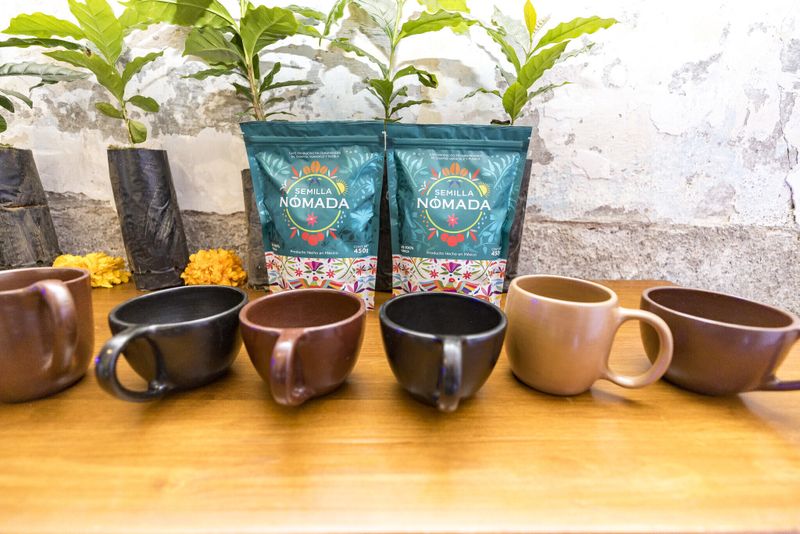
Most coffee farms produce under 10 hectares, creating an endless cycle of poverty and inequality. Currently, 171,668 producers cultivate less than 5 hectares, 3,791 cultivate 5 to 50 hectares, and only 218 cultivate more than 50 hectares. Coffee producers, often Indigenous peoples, face a long and unequal production cycle: production and maintenance costs are high, but income arrives only once a year, leaving them vulnerable to intermediaries and international price volatility.
Financial exclusion has traditionally prevented these producers from investing in better techniques, infrastructure, or quality certifications, leaving them trapped in a cycle of low yields and poverty. The AMUCSS model demonstrated, during the ILF summit, that the true richness of coffee lies not only in its aroma, but also in the hands that cultivate it. By connecting financial inclusion with sustainable production, each cup becomes a symbol of equity, autonomy, and rural pride.
Textiles and ceramics
In the remotest corners of Mexico, the hands of artisan women and men weave more than beauty: they weave identity, autonomy, and memory. The backstrap loom and hand-molded clay are the soul of entire communities, where tradition is preserved not in museums, but in the daily pulse of artisanal work. Textiles and pottery are more than crafts: they are forms of economic resistance and symbols of cultural dignity.
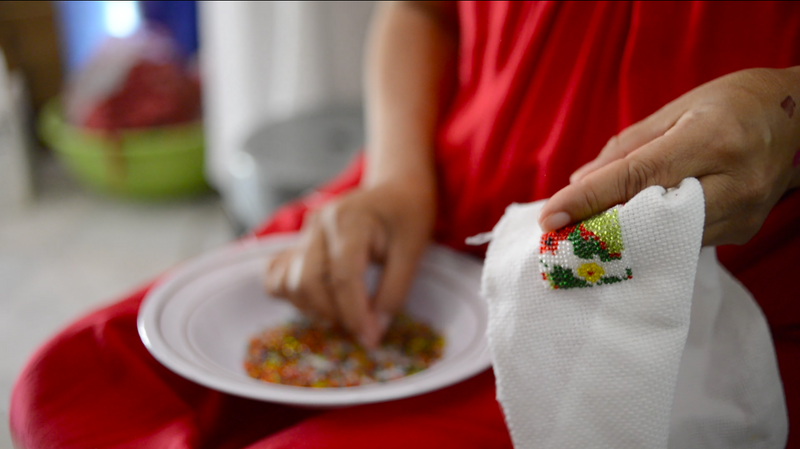
This is where the AMUCSS microbanks intervene, acting as the financial thread that unites tradition with prosperity. The microbanks are achieving real financial inclusion by offering solutions tailored to the specific needs of artisans with accessible and fair loans that allow weavers to acquire high-quality materials (such as the scarce native cotton (coyuchi) of Oaxaca or the chaquira needed for certain types of brocade). This ensures that art is preserved with the ancestral quality that gives it value in the market. Credit gives them the ability to purchase the necessary volumes of raw material (thread, chaquira, clay) before receiving payment for an order. This translates into: Greater production capacity to fulfill large orders, reduced waiting times, increasing competitiveness and consolidation of women’s roles as economic leaders by managing their own savings and credits.
The Altar: Tradition and financial inclusion
The Day of the Dead is not just a celebration: it is an act of collective memory. Each offering presented on November 1 and 2 honors those who came before us and reaffirms the Mexican worldview that life and death are not opposites but rather engage in dialogue.
In every marigold flower, in the scent of copal incense, and in the shared bread, there beats a community economy that unites generations. In Mexican syncretism, the offering represents a balance: what is harvested is shared. Similarly, microbanks facilitate the growth of community capital that makes this reciprocity possible.
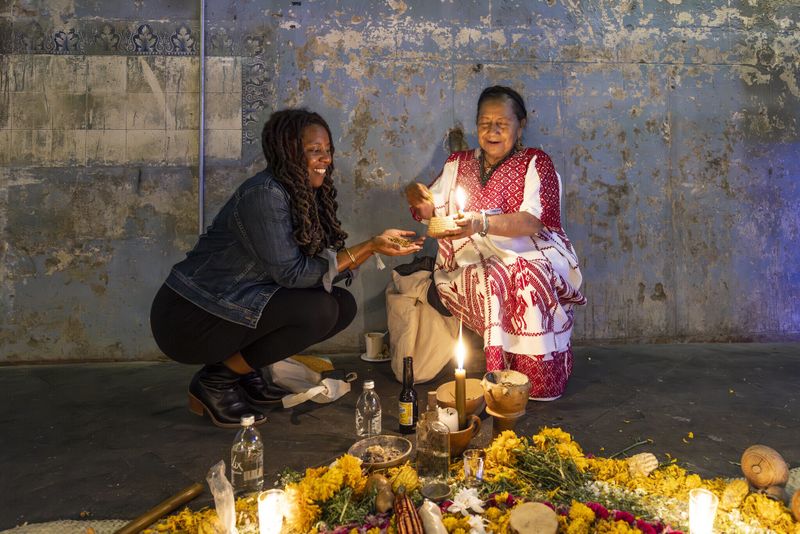
When they finance planting, crafts, or local production, they are sustaining the material basis that keeps spirituality alive. With each microbank that flourishes, AMUCSS protects more than just the economy: it protects the identity, memory, and autonomy of indigenous peoples. During the showcase, this tradition came to life involving every assistant, engineer and speaker by making them part of the ancient knowledge that is behind Mexican history and drives the need for financial inclusion. Even the deceased are included in life by commemorating their soul, therefore, people need to be part of a system that considers them in an integrated financial system.
Communications and Marketing
This effort was discussed and disseminated among the microbanks, in our social media and in our web page, which focused in our collaborative work with the Interledger Foundation and the People’s Clearing House.



Top comments (1)
what an amazing write up @amucss, thank you for sharing this!