

1. Introduce Your Team
We are Team Punch the Monkey — three DigiPen Singapore students who signed up for HackOMania 2026. I'm Nicholas, from the Real-Time Interactive Simulation (RTIS) programme. Benjamin is also from RTIS, and Shu Hng comes from Interactive Media & Game Development (IMGD). Although foreign, we covered the full stack between us and ventured into roles we had never tried.
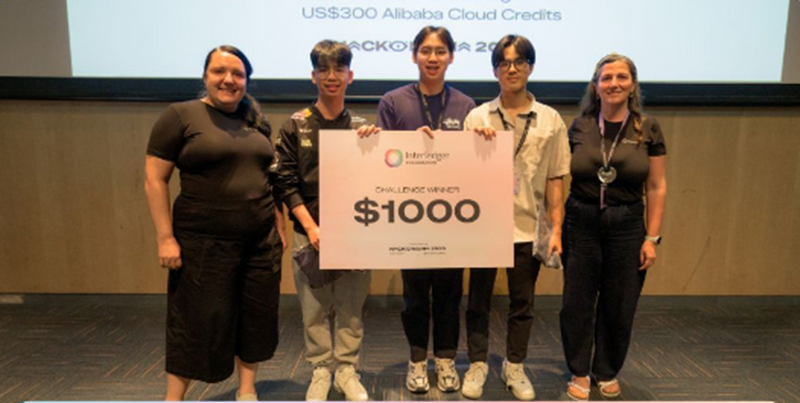
Winning moment — left to right: Timea Nagy, Benjamin, Nicholas, Shu Hng, and Ioana Chiorean.
2. Hackathon Experience
HackOMania 2026 was a 24-hour sprint, carried across 2 days, and the Interledger Foundation's challenge brief was what drew us in: design a programmable, community-driven emergency fund using Open Payments to collect micro-contributions and disburse aid based on verified disaster triggers. Reading it felt like a genuine engineering puzzle, not a contrived hackathon prompt. The turning point came early from the pre-event when we dug into the Open Payments API and realized the grant negotiation and wallet settlement logic could handle both inbound contributions and automated outbound payouts natively. That unlocked the whole architecture in one shot and gave us clarity on what to do for our 24 hours building.
3. Our Hackathon Background
This was our first hackathon for all three of us. We're students heading into internships soon, and there's something about a hackathon that feels like a rite of passage in computer science that we didn't want to skip. It's one of those experiences you hear about constantly, and we figured: if we're going to do it once before the next chapter starts, let's actually go for it. What surprised us was how different the pressure felt compared to coursework or even crunch on a game project. Every decision is permanent. You don't iterate; you discuss your ideas fast and move forward with resolve. That constraint turned out to be liberating.
4. The Problem We Tackled
When a disaster strikes, the people who need financial help fastest are usually the last to receive it. Traditional emergency funds are slow to mobilize, opaque in their rules, and rarely reach individuals directly. The Interledger Foundation's challenge asked: what if the fund were always funded, always on, and paid out automatically when conditions are verified — with no central authority making the call? That's the core of SafePool. Anyone can contribute before disasters happen, and when real-world disaster conditions are met, payouts flow automatically based on transparent, community-governed rules. Interledger's Open Payments protocol was the right foundation precisely because it's currency-agnostic and borderless. The protocol doesn't care where you are, which made a global fund actually feasible rather than aspirational.
5. Our Tech Solution
SafePool is a single global emergency fund platform, built in 24 hours:
-
Frontend: Next.js 16 + React 18 + TypeScript, with an interactive 3D globe dashboard (
react-globe.gl) rendering live disaster events and contribution activity in real time - Backend/Database: Supabase (Postgres) for transactional flows; ClickHouse (admittedly overkill for a hackathon project) for high-throughput real-time analytics
- Payments: Interledger's Open Payments protocol for all contribution and payout rails — grant negotiation, wallet addressing, and cross-border settlement
- Realtime Layer: Server-Sent Events (SSE) streaming live activity to the globe
- Governance: Community proposal and voting system for transparent, on-chain-style payout rules
The biggest architectural call was committing to a single global fund model rather than per-disaster pools. It simplified the contribution UX dramatically while preserving the rules for payout governance — you're always participating, not waiting for a specific disaster to fund. The trickiest part was handling the Open Payments grant flow for automated outgoing payouts, particularly managing grant expiry cleanly when a disaster trigger fires. We abstracted the payout trigger into a background polling service that checks disaster conditions and initiates payment grants automatically.
And then, somewhere around 3 AM, we also added the monkey.
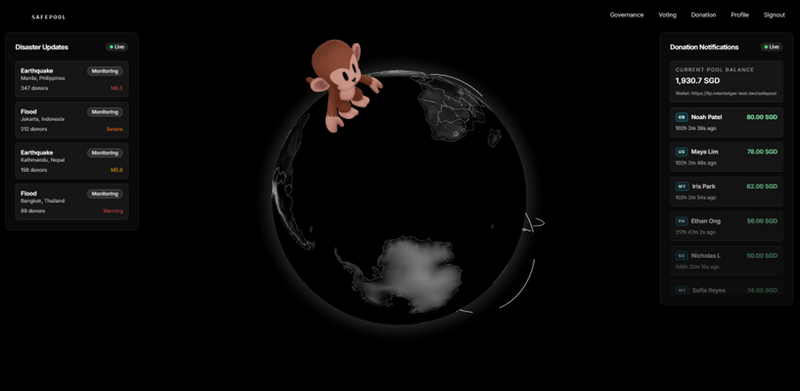
Punch the Monkey — our 3 AM mascot making his globe debut.
6. The Pitch
We were nervous. We had a live demo, a 3D globe, and a 24-hour build behind us — and we'd only tested the full payment flow successfully a handful of times before walking up. But the moment the judges saw the monkey on the globe, the energy in the room shifted. That idea came out of a very tired 3 AM conversation. We needed something that would make people remember us, and give the demo a personality. It worked better than we expected. The judges enjoyed it, and it became the thing people mentioned when they talked about our project afterwards. Beyond the mascot, the feedback that mattered most was that SafePool felt like a real product concept, not just a protocol demo. Winning first place for the Interledger Foundation Challenge out of 15 teams as first-time hackathon participants is something we're still incredibly grateful for.
7. Mentorship
We had the chance to consult with Timea Nagy, Ioana Chiorean, and Sid Vishnoi from the Interledger team throughout the 24 hours. Rather than just technical guidance, the conversations were more like product reviews. They pushed us to think about what we wanted SafePool to feel like in a real-world scenario, what the payout governance should prioritize, and how to use the Open Payments tooling in a way that served the user experience rather than just satisfying the integration checklist. That clarity helped us make faster decisions during the build and kept us from going down rabbit holes that wouldn't have made the final demo stronger. We're grateful they took the time to come down to this event, especially with other teams competing for their attention.
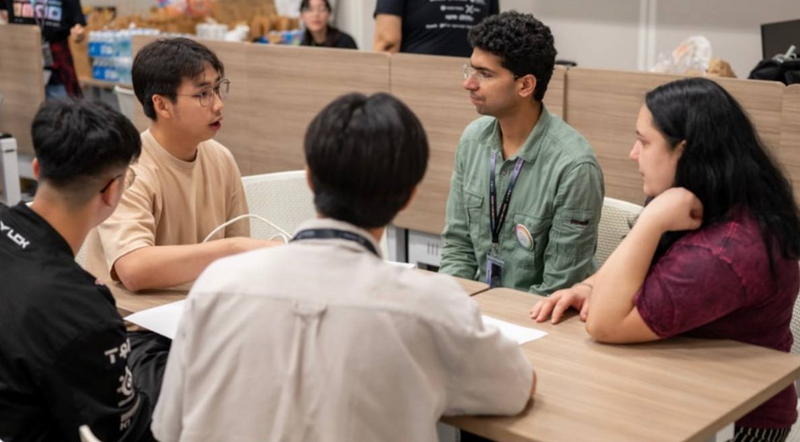
With the Interledger mentors who helped shape SafePool — left to right: Team Punch the Monkey, Sid Vishnoi, Timea Nagy.
8. What's Next
SafePool is live at safepool-two.vercel.app and open source at github.com/struccomaker/safepool. As we head into our internships, the project is something we're genuinely proud to have shipped. The next meaningful step is moving off the testnet onto real Open Payments wallets and integrating more robust disaster oracle data so the trigger logic doesn't rely on a centralized source. If you're working on Open Payments, disaster relief infrastructure, or just want to hack on the governance layer, we'd love to hear from you.
Reach out to us here:



Top comments (5)
Wow, fantastic work team 🚀
And this is such a quotable quote:
Congrats, Team Punch the Monkey! What a major achievement.
All the best to you during your internship. I look forward to seeing more of your work in the future!
great work Punch The Monkey team!!!!
Amazing teamwork, and it was a pleasure mentoring you, then being part of your win.
Love it, congrats!