



Where design, education, and infrastructure meet the future of money.
Welcome back to the Digital Money blog series.
In the previous series, we explored the waves of disruption and experimentation that marked the early rise of digital money. Those blogs sparked valuable insights and dialogue across the Interledger ecosystem on what resilient, inclusive, and interoperable financial systems might look like in an increasingly digital economy.
Since then, the discussion around digital money has matured.
Our ecosystem includes a wide cross-section of technologists, developers, academics and innovators who are actively shaping the foundations of tomorrow’s financial architecture. A shift in the discussion is evident and beyond what is technically possible towards deeper understanding around:
- What systems are sustainable?
- What designs are equitable and inclusive?
- What infrastructure will remain secure and trustworthy in a rapidly digitized world?
As these questions grow more urgent, this series enters a new phase: one focused on intentional system design.
The Future of Money is Being Designed
Digital money is not emerging by chance. It is being deliberately designed, through choices about technology, governance, policy, and education. With this shift comes a new perspective. Instead of focusing only on broad industry trends, this series will explore more fundamental questions:
Where are the future architects of digital money being trained? Who will design, build, regulate, and maintain financial systems for decades to come?
Interestingly, but not unexpectedly, the answer points to: Universities.
Across the world, classrooms, research and innovation labs, and interdisciplinary programs are preparing the next generation of technologists, economists, policy specialists, and financial innovators who will shape the digital financial ecosystem. Universities are no longer just observers of digital finance, but are becoming active laboratories for the future of money where ideas are tested, talent is cultivated, and emerging norms are quietly shaped.
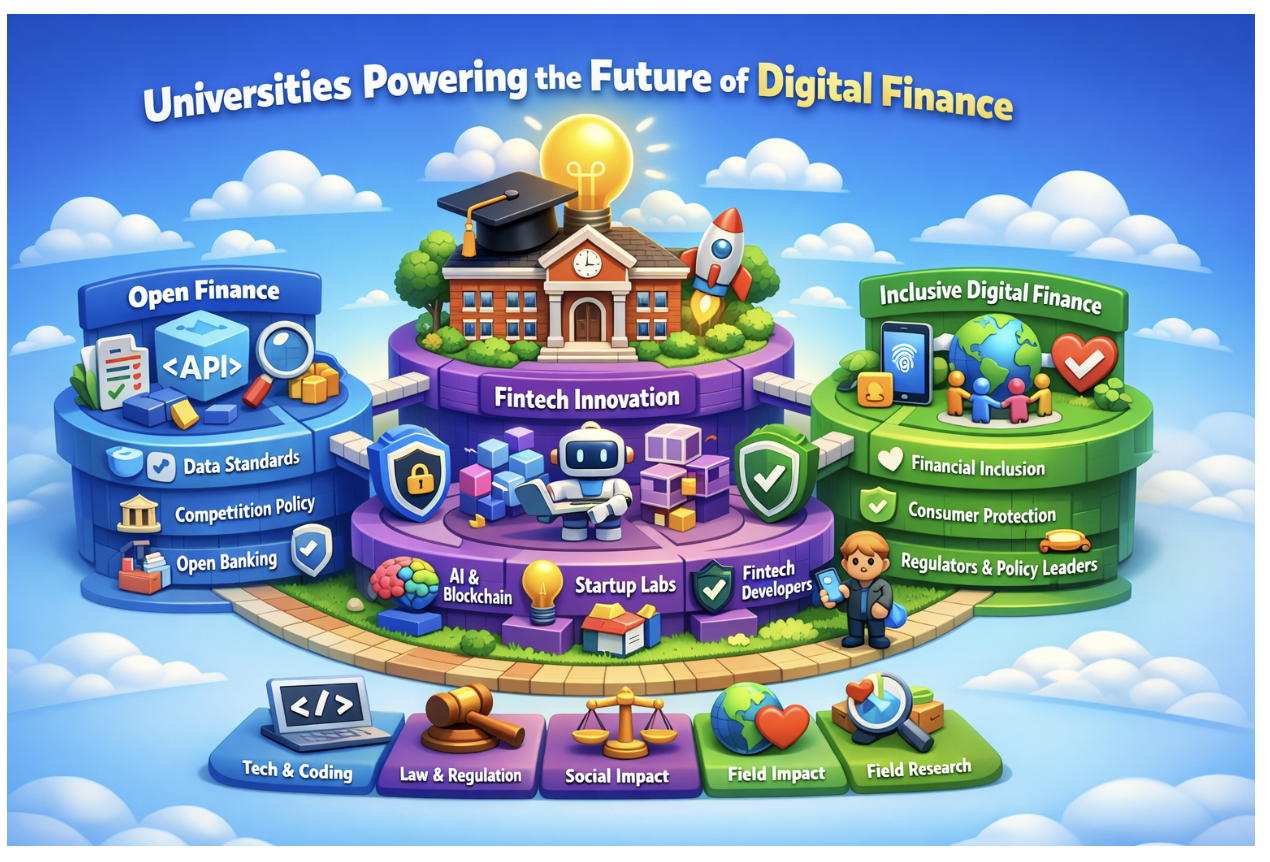
The New Architects of Digital Money
By focusing on universities in 2026, this blog series aims to surface an important shift. Academic institutions are rapidly becoming environments where:
- Curricula are evolving to include digital finance, fintech infrastructure, and payment interoperability.
- Research agendas align with real-world policy and market challenges.
- Students develop interdisciplinary skills needed to build and govern digital financial systems.
Across campuses, new programs blend computer science, economics, law, public policy, and ethics. Research centers and innovation labs prototype payment systems, explore the implications of programmable money, and study how digital finance impacts communities. A new generation is emerging, in which students are being trained to become future fintech developers, payment infrastructure engineers, and regulators. Understanding where they learn, and what they learn, helps us understand how digital money itself will evolve.
Highlighting the work of universities matters because digital money is no longer purely a technical challenge. It is a societal one. The design choices made today will shape fundamental aspects of financial life for generations to come, including: privacy, access to financial services, competition in financial markets and public trust in digital systems.
Universities have a central position within this landscape as they provide:
- Intellectual independence to question dominant financial models
- Institutional memory to learn from past financial transformations
- Educational mandates to prepare professionals capable of navigating complexity
Universities offer a rare neutral space to explore digital money without immediate pressures from profit, politics, or platform dominance. This neutrality matters.
Academic environments can bring together engineers, designers, legal scholars, social scientists, and students for shared inquiry. Together, they can ask not only whether digital money works, but also: Who benefits? Under what conditions? According to which values?
At the same time, universities are increasingly engaging with real-world financial systems. Experimentations are emerging across campuses, including digital wallets for campus ecosystems, programmable payments for research grants and scholarships, and credential-linked digital identities. These are not abstract exercises. They are hands-on experiences shaping how future generations understand and interact with digital financial systems.
Enabling Universities
The Interledger Foundation (ILF) has been working with universities and colleges around the world as they explore these questions. Through funding, experimentation, pilot programs, curriculum development, and interdisciplinary collaboration, the Interledger Foundation helps ensure the next generation of digital money is equipped with knowledge on interoperability, openness, financial inclusion and public interest design.
To learn more about our past initiatives you can watch the Interledger on Campus Webinar, read about the 2025 Interledger Summit session, From Classroom to Codebase: How Universities Cultivate the Next Generation of Open Payments Talent, and also view our Education grant page.

This series is an invitation to think differently about digital money. Not as a finished product but as an evolving system, one that must be designed, taught, tested, and challenged in the open.



Top comments (0)