


The Payment Problem We're Exploring
Communities on Blacksky and the wider AT Protocol network already organize, fundraise, and care for each other on the open social web. But the moment money needs to move, they have to leave. Organizers drop a Venmo link, a Cash App tag, or a crowdfunding page, and each hop breaks context, hands personal data to another company, and locks people into a provider that may not serve them. For Black, Latinx, immigrant, and low-income users, who already face documentation barriers and discriminatory account closures, those closed systems are often the weakest link.
The AT Protocol ecosystem now reaches roughly 45 million people; mutual aid networks have become everyday survival infrastructure since the pandemic, and many people are pulling back from mainstream platforms and financial apps out of fear of surveillance. The open social web still has no native way to move money. We want to explore what happens when it does.
Who Is This For?
Blacksky Cash is for community builders, organizers, and the wider community on AT Protocol. Our story begins with mutual aid: making it simple to send and receive money within the communities people already belong to.
Our core scenario: a mutual aid organizer on Blacksky needs to pay a neighbor by their AT Protocol handle, funded from and cashed out to any Open Payments wallet, across wallet providers and hosting servers, so they can move money where their community already organizes.
The sender is the organizer. Today they juggle several apps, ask neighbors which payment service they use, and copy account details between platforms. The receiver is the neighbor, who may not use the same app, may be underbanked, and may be wary of sharing data with yet another company. A flow where you pay someone by the handle you already know, from the wallet you already have, would remove most of that friction.
What We Want to Test
We believe Open Payments can help mutual aid organizers and their neighbors on AT Protocol to send and receive money by social handle by giving them one standard way to fund from, and cash out to, any Open Payments wallet, whichever provider or host each person uses.
Open Payments is relevant because it offers a shared language for wallets, consent, and payments that isn't tied to a single company. That matches the open social web, where people can already move their identity between hosts. We want to learn whether a standard wallet address can be securely linked to a decentralized social identity, whether consent screens on a user's own wallet feel clear and trustworthy, and whether Open Payments can sit alongside our existing regulated banking rail without changing the rest of the product.
The Payment Flow We'll Explore
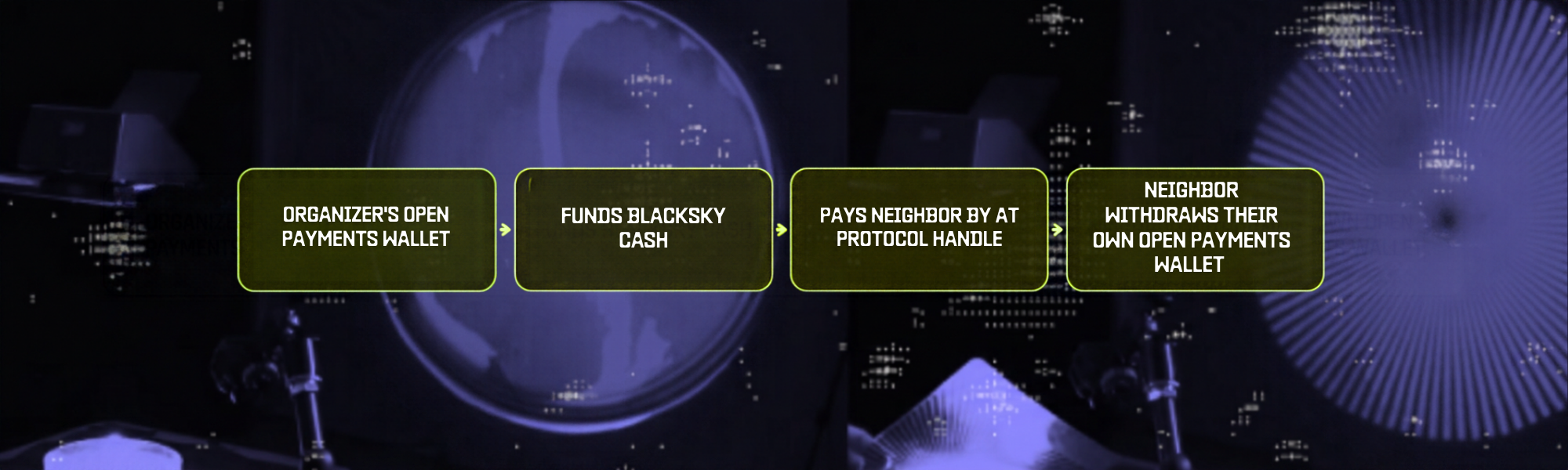
We will demonstrate one journey on the Interledger test network, in three steps:
- Fund. The organizer links their Open Payments wallet once, then adds money. They approve the payment on their own wallet's consent screen, with a capped amount, and receive the same value as digital cash in Blacksky Cash.
- Pay by handle. The organizer types their neighbor's handle. Blacksky Cash looks up the neighbor's identity, and the payment arrives in their inbox as an encrypted delivery. The servers that host users' accounts only ever see scrambled data, never amounts.
- Withdraw. The neighbor cashes out to their own linked Open Payments wallet. Both wallets show matching amounts, and any unused fee comes back as change.
How We Plan to Use Open Payments
Blacksky Cash moves dollars as private digital cash (e-cash) between AT Protocol identities. The dollars themselves sit with a regulated partner that backs every token one-to-one. Open Payments becomes the way money comes in and goes out, next to the banking rail we already use.
We plan to use these Open Payments capabilities:
- Wallet addresses and grants. A user proves they control a wallet address, and we link it to their AT Protocol identity. Withdrawals can only go to that linked address, which protects users from misdirected or fraudulent payouts.
- Incoming payments. When someone adds money, an incoming payment on the operator's reserve wallet acts as the invoice.
- Quotes and interactive outgoing-payment grants. Users see the cost up front and approve every payment on their own wallet's screen, not ours.
- Outgoing payments. A withdrawal becomes an outgoing payment from the reserve to the user's linked wallet.
Behind the scenes, the mint operator runs Rafiki, Interledger's open-source wallet software, and our payment service plugs into it. The same build can run on our existing rail or on Open Payments by changing a single setting.
What We Hope to Demonstrate
By the end of the four-month Accelerator, we aim to demonstrate a working, open-source proof of concept on the Interledger test network: an organizer funds Blacksky Cash from an Open Payments wallet, pays a neighbor by handle, and the neighbor withdraws to their own Open Payments wallet.
We'll know the experiment worked if:
- The wallets agree. The sender's wallet shows the debit, the recipient's shows the credit, and the amounts match both quotes and our payment records.
- Failures are safe. A declined consent, an expired quote or a failed payout each leaves the money with the user.
- Swapping rails is a setting, not a rebuild. One build and one set of data formats work on both our existing rail and Open Payments, while hosting servers still see only encrypted data.
Looking Beyond the Accelerator
If the experiment succeeds, the next step is moving from the test network to real Open Payments wallets, so anyone can fund and cash out with the provider that suits them. We plan to launch with communities in the US, starting in New York City, where most of our team is based, alongside a full legal and compliance review.
From there, we aspire to bring group accounts to Blacksky Cash. Inspired by West African susus, or rotating savings circles, these let collectives pool funds, fundraise, and vote together to release money. We also see tipping, crowdfunding, and creator support as natural next steps. Because everything is open source, other AT Protocol builders can reuse the infrastructure, and we hope to grow with financial partners internationally.
What We're Excited to Learn
On the technical side, we want to learn how best to link an Open Payments wallet address to a decentralized social identity, and how a privacy-preserving e-cash service can work hand in hand with Rafiki. We'll also be testing how cleanly Open Payments fits alongside a regulated banking rail.
On the people side, we want to understand how consent screens and in-app education land with users. Many in our communities have well-founded distrust of financial systems, and many can't easily tell regulated digital dollars from speculative crypto. Building trust takes more than secure technology, so our trust and safety lead will shape how we explain every step.
We plan to contribute back an open reference implementation, a published spec, and lessons on linking social identity to Open Payments wallets for other builders in the ecosystem.

Blacksky Algorithms builds community-first infrastructure for the open social web. Blacksky is home to a largely Black and Latinx, politically engaged community in the United States, and our servers host roughly 3 million users, including Latinsky. We run a full production AT Protocol stack written in Rust, and we've contributed features like private posts and collective governance to the wider ecosystem.
Many of us are longtime mutual aid organizers. We started Blacksky Cash because we kept seeing the gap between where community happens and where money moves, and because the communities we serve deserve financial tools built by people they trust. Payments are the next step toward an open social web that truly serves them.



Top comments (1)
Great work 👏👏