



Hop Sauna is a core technical stack aimed at developers to support implementing a federated, community-moderated web shop offering custom digital objects.
Project Update
Those who wish to lead change have a responsibility to demonstrate and build trust with the communities and individuals we hope will support us.
Our online activity is fraught with dark patterns, described by Caroline Sinders in her Ambassador Report. For open payments to reach greater acceptance by regulators, buyers and sellers, we have to demonstrate greater ethical responsibility than the alternatives. More than that; we have to be easier to use, easier to understand, and safer for everyone.
Supporting African creators
The community I most wish to bring online are African authors on the continent who struggle with financial exclusion.
Even if you are a well-published, famous African author in the diaspora - a Suyi Davies, Nnedi Okorafor, or Tade Thompson - that doesn't mean you can reach African readers. And, if you're an African living on the continent, you can give your work away on any of the major platforms - as Dilman Dila does on YouTube - but you struggle to charge for it.
And then there are the horror stories. Anyone who has ever self-published on Amazon knows how hard it is to sell even one book. A few years ago Chovwe Ekpeki, a Nigerian author, edited an anthology of African scifi which he modestly called The Year's Best African Speculative Fiction. Listed on Amazon's US site, he managed to sell $2,000 of books. Just before he was due to be paid out, Amazon notified him that Nigerians weren't eligible to sell, and they closed his account, and took his - and his contributors - money. This was eventually sorted out, but it left us all with a sense of how tenuous is our relationship with these platforms.
And so we come to our challenges: we are not able to gain access to readers, we can't get paid by the places we publish, and our readers can't always use the ways they are used to paying - like mobile money - online.
Hop Sauna release
I'm struck by just how fundamentally weird the contemporary internet has become. It's got the diversity, curiosity and innovation of a small agricultural town in middle America, or even somewhere in the Northern Cape. In many parts of the world, Facebook is the whole of the internet, just like Amazon is the place you shop. Discovery and purchase happens exclusively in properties controlled by such a small number of companies.
You can judge how far into the barren wastes of the web you are by how often the site you're visiting pressures you into subscribing to their newsletters and build an account there. They're desperately worried they're about to lose you forever.
When I started developing Hop Sauna, I wanted to break these walls open to the wild early internet. I want software that encourages connection, is moderated by the creators who sell their work on that site, has some friction to launching new products so that it feels more intentional, and I want payments to be low-cost, and direct between buyer and seller.
Some of this leans into the growing community of ActivityPub social websites, like Mastodon, but a lot depends on Interledger's success with open payments.
Consolidating everything I've learned this year is still a work in progress, and this report is a continuation of my interim report.
Progress on Objectives, Key Activities
If you know your Clausewitz, no plan survives contact with reality, or your Tyson, where everyone has a plan till they get punched in the face, these are my original goals, and how they evolved.
Goal 1: deliver a template developer stack ready for custom creation of creator community-moderated Open Payments-enabled web shop
Hop Sauna is available as an initial release. There is a great deal of documentation for developers, and much more to be done.
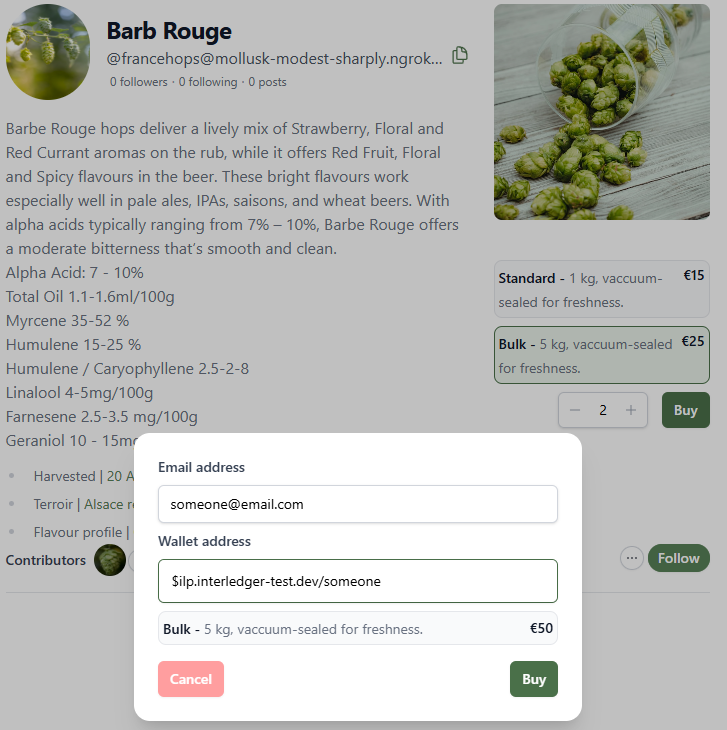
This went more or less as expected, although the steepness of the learning curve, and the challenges of working with relatively immature software, did cause delays as I grappled with getting everything into my head.
Goal 2: develop marketplace tools for facilitating buyer and seller exchanges, including for webhooks for responding to successful purchases, disputes and refunds
Here I was limited by the provisional state of the Python Open Payments Developer Kit. Over the course of my project, I refactored and redeveloped the kit, with the following updates:
-
Model refactoring and fixes: generated code resulted in models that don't return data, or duplications and deeply-nested
RootModelsmuch of which could be deleted and simplified. -
New convenience functions: testing the API effectively requires building a full purchase workflow, but such a workflow is also useful to developers using the SDK. The
READMEin theprocessfolder details the main objectives and roadmap, and this update implements the simplest possible payments workflow for purchase and sale. - Updated tests: all the tests should be refactored, especially as private endpoints have been committed to the repo. Tests for the convenience functions run through a complete workflow, and use the new environment variables to safely do a real-world test on the Rafiki test server.
There is currently a pull request awaiting review.
Further development on the open payments aspect of Hop Sauna awaits on approval of this pull request.
Goal 3: kick-start cooperative creator marketplaces through engaging with stakeholders to align the template stack with their needs, and to develop a supportive environment for project sustainability
Early in 2025, I convened a group of African SFF authors from around the world to discuss how best to serve their needs. The group includes:
- Cheryl Ntumy: Ghana-based SFF author and founding member of Petlo Literary Arts, a non-profit that develops and promotes creative writing from Botswana. She is also a founding member of the Sauútiverse Collective, an African speculative fiction collaborative worldbuilding project.
- Dilman Dila: Ugandan writer, film maker and a social activist. His books include Where Rivers Go To Die, which was shortlisted for the PKD Awards (2024), his films include, “What Happened in Room 13”, has been watched more than 8 million times online. He is currently working on his third feature film, about decentralized governance.
- Ivor Hartmann: Zimbabwean writer, editor, publisher, and visual artist. Awarded The Golden Baobab Prize (2009), finalist for the Yvonne Vera Award (2011), selected for The 20 in Twenty: The Best Short Stories of South Africa’s Democracy (2014), awarded third in the Jalada Prize for Literature (2015), and Nommo Awards nomination (2017). He also runs the StoryTime micro-press, publisher of the African Roar and AfroSF series of anthologies, and most recently ZamaShort.
- Ayodele Arigbabu: is a writer, architect and creative technologist with close to two decades of experience in delivering projects at the intersection of architecture, design, film, digital media, publishing, event production and curation, as well as in the development of digital and interactive arts and applications. His short story "You Live to Die Once" won the 2001 Liberty Bank Short Stories Prize; his poem "Livelihood" got an honourable mention at the 2003 Muson Poetry competition. His stage play Moremi: The Legend Retold was staged in December 2003 at the University of Lagos Main Auditorium to an appreciative audience, and went on to be performed in Oklahoma and at the National Theatre of Nigeria.
- Suyi Davies Okungbowa: award-winning author of fantasy, science fiction and general speculative fiction. He has published various novels for adults, the latest of which is Son of the Storm (Orbit, 2021, first in the epic fantasy trilogy), The Nameless Republic (the second book in the series, Warrior of the Wind, 2023). His debut novel, David Mogo, Godhunter (Abaddon, 2019) won the 2020 Nommo Award for Best Speculative Novel.
- Jude Umeh: published author and thought leader on the intersection of emerging technology and Intellectual Property on Digital Content and Rights, Umeh currently works as a Director of AI Business Strategy with Salesforce Professional Services.
Much of what follows is influenced by the guidance of this group. Many of them expressed reservations that they could understand or contribute to the tech, but I pointed out that it's not their job to understand the tech. It's my job to understand their needs and then reflect that back to them using the tech.
What impact does the project have on your perception of digital financial inclusion?
I feel more encouraged after this past year than I was at its outset. I have entered my Ambassadorship with a "show, don't tell" strategy, preferring to build and demonstrate what I'm doing than to simply talk about it. The more I engage, listen and learn, the more viable my approach for federated, collaborative social marketplaces feels.
Certainly, there is a long way to go, but the solutions offered need to be better than what exists, not be perfect on the first attempt.
A lot rests on the success of the open-payments enabled payments providers and wallets, and these are still in a very early stage. However, if we don't also have the ability to rapidly implement webshops using open payments, then that time and investment will remain unfulfilled.
Until then, the best hope for the future is to keep building.
Project Impact & Target Audience(s)
There is something in innovation I call the Milk Problem.
Everyone knows what milk is. If I bring you a new type of milk, I don't need to explain what it is, just tell you how it is different from other milk and why you should buy it.
Push your innovation further out, and you end up in a place where no-one knows what it is you're offering them. You first have to explain everything about that thing before you can get around to the product itself and why people should buy it.
Hop Sauna is not "milk". It is a framework for a new type of federated social commerce which doesn't exist formally as generally-available software. Sure, it builds on social publishing and leans on existing commercial models, but it is complex to explain quickly. People don't necessarily have a mental model for it.
My author's group discussed ways in which they want to be paid and I then structured this into a set of archetypes:
- One-off: a payment - usually of purchase and sale - between a buyer and seller which happens once.
- Recurring: a payment - usually a subscription, or structured fee - between a buyer and seller.
- Conditional: a payment which is conditional on some additional factor - e.g. the seller is required to perform some task, or a threshold of purchases are required - before funds are transferred.
This covers everything from an Amazon purchase, to Spotify streaming subscriptions, to Kickstarter campaigns or even an Uber taxi trip.
There are a myriad of these types of requirements. Each of them needed to be documented, understood, mapped to methods in Open Payments or ActivityPub, and then represented in ways that can be understood by developers, and potential buyers and sellers using that software.
The challenge is many developers have little experience of the challenges of the financially excluded, and the financially excluded don't often get a voice in the technical solutions developed on their behalf.
Hop Sauna needs to integrate this dynamic by default without causing anyone to realise they have no idea what milk is.
I think I'm getting there.
Communications and Marketing
2025 Interledger Summit Mexico City
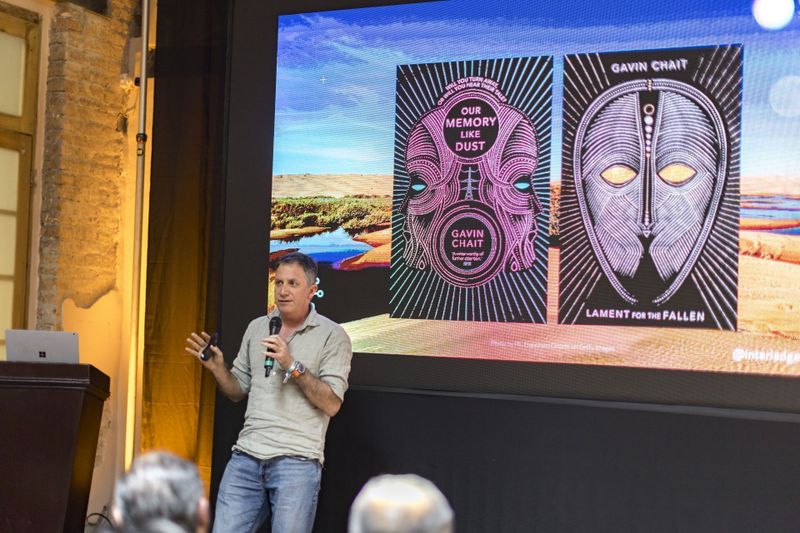
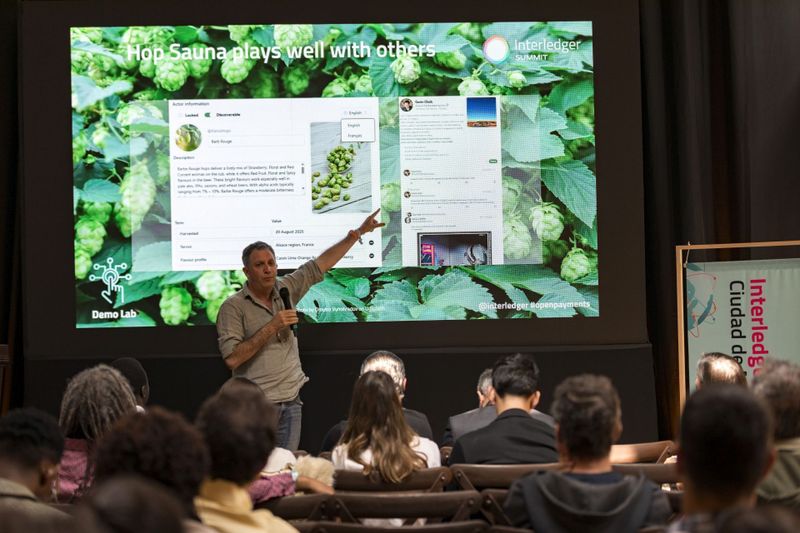
I presented the first release of Hop Sauna at the 2025 Interledger Summit in Mexico City, as well as charting out where we are, and the sorts of apps I'd like to see arising from my work:
As examples, consider cooperative versions of Uber, where groups of drivers regulate and manage themselves, and have a direct relationship with their passengers:
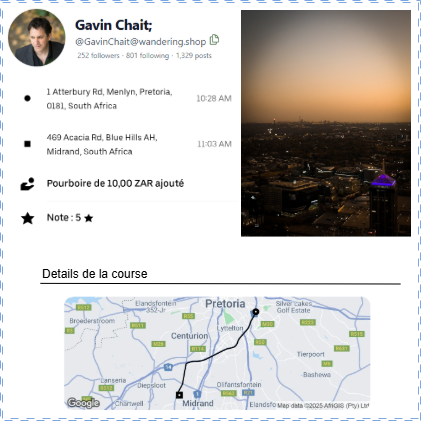
Or a Booking.com alternative, where guesthouses and hotels don't have to pay intermediaries to handle their bookings for them:
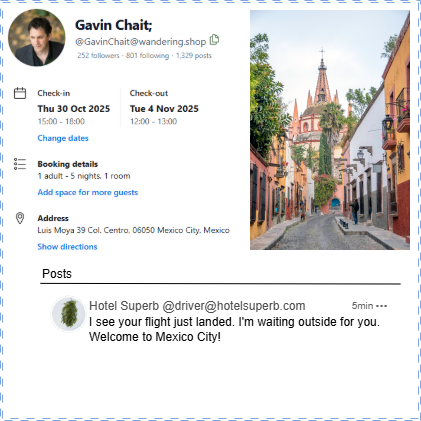
2025 Interledger Hackathon Mexico City
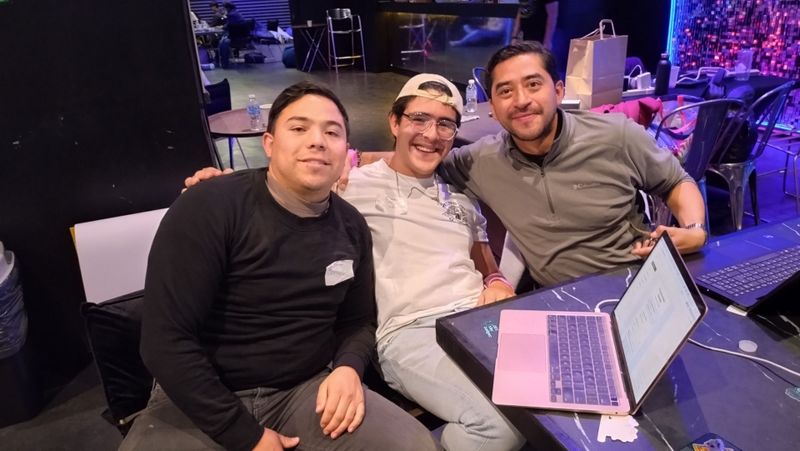
I was a mentor at the hackathon, during which teams attempted to build new applications for open payments. This gave me first-hand experience of the types of challenges developers face when using open payment development kits, and also to gauge interest in more enhanced features for the toolkits.
I also had the rare pleasure of having two teams adopt Hop Sauna during the event and deliver completed submissions using it.
Podcast
Cheryl, Dilman, Jeremiah Lee from the Foundation, and I collaborated on a podcast, published in December last year.
This covers much of the ground we considered during my Ambassadorship, ranging from the cascade of transactions necessary to get money from publishers in the US into the hands of authors, to platform exclusion, to the multiple ways we need to borrow identities from others with more privilege just to get things done.
I have also begun engaging with some of the key developers and infrastructure designers of the fediverse to ensure that Hop Sauna plays well with others.
What's Next?
Hop Sauna extension
There is an initial set of moderation hooks, and I will be focusing on extending this in Q1 2026.
My working plan so far is to implement the following:
- Site level:
- Universal block lists
- Geotargeting - fairly blunt, but using IP addresses to isolate "bad places"
- Actor level:
- Individual blocks/mutes at site and actor level
- No reply except for direct messages, and limit direct messages by default to followers only (they can open this, if they wish)
- Detachable reposts for the inevitable shark-baiting. Given many stacks aren't yet implementing this. I figure it works more like a mute.
- Geotargeting of individual actors with options to block, show different information, or offer a different price. This works on multiple levels from the way I was originally thinking of it (offering books for sale only in certain countries) to the limitation of products which may be illegal outside of certain jurisdictions.
This mostly reduces clutter and problems on the commercial server, but a repost on another server probably supports replies there. Again, a functional mute on main.
The more specific commercial limits will be:
- Dunbar's limit of 150 creators (any number of supporters, depending on the type of service - on my Kindle-alt, readers have accounts to store and read their books).
- All Actor Services (products) can only be made public by an approved editor with those rights.
- Messages are all generated, meaning you can only send a message to your followers when a specific type of action occurs (publishing a book, offering a period-limited discount, that sort of thing).
None of that stops individuals reposting their product announcements on their other socials, but there they would be limited by the rules of those communities.
The Dunbar's limit includes an extension - the stack name cannot be a creator server. As example, the Kindle-alt will be called Qwyre (rebuilding my existing https://qwyre.com which stopped working commercially when Coil was closed, but still works perfectly well as my main ereader). Qwyre itself will be closer to something like JoinMastodon, and eventually become a federated search engine for books from all the different imprints (servers).
I think it's critical to ensure distribution and discovery to prevent agglomeration effects that overwhelm safe communities.
Qwyre for self-publishing
I have a new novel. My intention is to dust off the old Qwyre and build a new Kindle-alternative where I can collaboratively publish my work.
Community Support
I would appreciate the following:
- Code review
- Feature development
- Internationalisation
- UX / UI
- Unicorn Hunters
This latter is aimed at developers who want to build on Hop Sauna with apps targeting existing monopoly commercial tech, like Amazon, Kickstarter, Uber, etc.
Oh, and funding. I'm always looking for funding to support continued development.
I wish to thank Interledger for their support, and look forward to everyone's thoughts on progress to date.



Top comments (1)
Thank you for submitting your final report! It was a pleasure having you as one of the 2025 Interledger Ambassadors. I'm looking forward to seeing what the future holds for this project.