
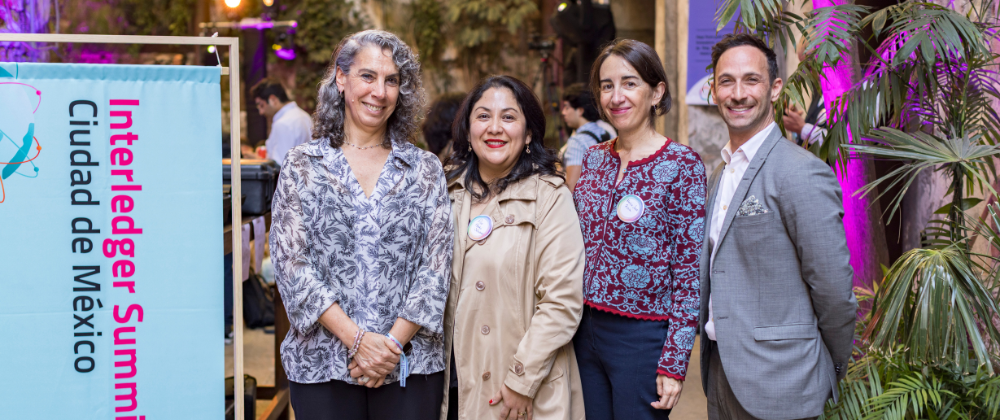

A Session Summary from the Interledger Summit 2025
At the Interledger Summit 2025 in Mexico City, the panel “From Access to Wellbeing: Designing Financial Tools Women Can Trust and Use” confronted an uncomfortable truth about Latin America’s financial inclusion efforts: despite years of programs and policies, the gender gap in financial inclusion and wellbeing is widening.
Moderated by Jeffrey Bower, former IFC lead for the financial inclusion of underserved populations, the conversation brought together three leading experts: Carolina Trivelli, senior researcher at Peru’s Institute of Studies (Instituto de Estudios Peruanos) and former Minister of Development and Social Inclusion; María José Roa, an international consultant and researcher with 30 years of research experience; and Pilar Islas Rodríguez, Director General of Nowi Soluciones, which develops financial education programs for vulnerable populations in Mexico. They agreed that counting how many women have bank accounts is not enough. Progress depends on understanding the cultural, structural, and institutional barriers that stop women from using financial services to improve their lives.
The Paradox of Progress
Latin America shows a clear contradiction. As Trivelli noted, “The gender gap in Latin America has not been reduced. Even if there’s more access to products and services, we haven’t been able to translate this into women’s inclusion.” In other emerging markets, gender gaps have narrowed. In Latin America, they persist or have grown.
The COVID-19 pandemic sped up digital financial inclusion through government transfers to e-wallets, but underlying inequalities remain. Roa pointed out that while the holding of digital products has increased and gaps have narrowed in some countries, “the gap in digital skills and digital financial inclusion for women remains high.”
There are also strong differences within the region. Argentina, Brazil, Uruguay, and Chile show smaller gender gaps; others lag behind. Chile offers one promising example. The financial superintendent in Chile began measuring and publicly reporting discrimination in lending practices. “What is not measured is not seen,” the superintendent concluded. Once Chilean financial institutions saw explicit data on discriminatory lending conditions, it sparked difficult but necessary conversations about reform.
Beyond the Binary of Access
The panelists pushed back against the idea that financial inclusion can be measured only by whether someone has a bank account. “Financial inclusion does not mean having only one financial product,” Roa stressed. “We need a multidimensional lens.”
This complexity appears across all income levels. Even high income, highly educated women face barriers. Many choose less profitable investment products because they do not trust their own financial decisions. When women investment advisors work with these clients, it “radically changes the kind of decisions they make,” said Trivelli.
For lower income women, the obstacles are more basic. Islas Rodríguez’s field research in southern Mexico found that many women do not have their own mobile phones; the family’s single phone belongs to the father or son. In central Mexico, women often have analog phones and use them only for calls. In the north, women may have smartphones but still hold strong cultural beliefs: “The bank is bad. Please do not get a loan. It is a problem that you will have forever.”
The Trust Deficit
A recurring theme was the lack of trust in digital financial services among vulnerable women. Mejía Flores described this gap: “For many people, especially people who are poor, the digital experience is not this vision that it facilitates and streamlines everything. They have a different experience. The digital experience is that the commissions are not clear, or sometimes they are indebted and it’s not clear for them how they are going to pay it off.”
These negative experiences create a vicious cycle. Women often withdraw government transfers in full as cash rather than using digital services, which limits their ability to build a financial history and access credit. “They rather withdraw money and use their cash because they know how to handle it,” Mejía Flores explained.
More apps or products alone will not fix this. In a pilot program where Islas Rodríguez’s organization achieved 54% women's adoption of credit cards, success came from human-centered design: women advisors who understood clients’ realities, peer-to-peer communication, and extensive education on best practices. Trust was built through relationships, not algorithms.
The Informal Economy Reality
Latin America’s large informal economy adds another layer of complexity. Trivelli noted that in countries like Peru, while 67% of women work, 89% are self-employed or in the informal sector, often juggling caregiving with income generation. “By definition, their entrepreneurship and their livelihoods are more fragile,” she explained.
Yet financial institutions often design products for formal workers or for businesses that are expected to grow quickly. These products do not match many women’s lives. “The financial institutions have a fantastic product aimed at women, the advisors are experts, but the objective is that they make their business grow,” Trivelli said. “Many women cannot make their business grow because they do not have the right time to work.”
Instead of trying to replace informal practices, the panelists called for recognizing and strengthening them. Women already manage complex financial lives through tandas (rotating savings groups) and community lending schemes. As Islas Rodríguez observed, “Women are using financial services. Most of them are using informal ones.”
National Strategies: Necessary but Not Sufficient
Mexico is developing a national financial inclusion strategy with a specific focus on indigenous women, a unique example in the region. Still, the panelists cautioned against overestimating what strategies alone can achieve.
“National financial inclusion strategies have been heavily criticized,” Trivelli acknowledged. “Because they stay on paper, because they’re not sufficiently robust, because they don’t mobilize resources.” Yet she defended their role as a coordination tool: “The challenge of women’s financial inclusion is multidimensional, and therefore requires various articulated policies and a consensus in the initial diagnosis. This is impossible to happen in a vacuum.”
The real test is implementation. Many strategies recognize women’s financial exclusion in their diagnostics but stop there, without gender-specific objectives. Without measurable goals, specific actions, governance and responsibilities, and resources, efforts remain fragmented and weak.
Effective strategies need legitimacy through multi-stakeholder participation, institutionalization, broad socialization, and constant measurement, monitoring and evaluation. They must also recognize that financial inclusion is a means, not the final objective. “Financial inclusion is a means to reach financial health, financial wellbeing, better management of our finances,” Trivelli emphasized.
The Stakes of Inclusion
The discussion underscored that women’s financial inclusion is not only a fairness issue; it is central to economic development. Women with economic independence face less violence, gain more decision-making power, and invest more in their families’ wellbeing.
Reaching that point requires more than extending existing products to women. It calls for a fundamental rethink of how financial services are designed, delivered, and regulated, that take into account the invisible barrier of gender social norms
As Latin America confronts widening gender gaps after years of financial inclusion programs, the panel’s insights suggest that the next phase must focus on women’s lived realities. Progress depends on institutions understanding and responding to women’s complex economic lives. The goal is not just inclusion on paper, but financial health and wellbeing that allow women to thrive in increasingly digital economies.
Pathways Forward
The panelists pointed to several concrete steps for improving women’s financial inclusion:
- Transparency and measurement: Following Chile’s example, institutions should publicly report gender-disaggregated data on product use, lending conditions, and service quality.
- Product design with women’s input: Institutions should design products based on women’s real financial needs and constraints, not simply rebrand products originally made for men.
- Recognition of intersectionality: Women are not a single group. Strategies must reflect the different realities of indigenous women, rural women, entrepreneurs, and others.
- Understanding, measuring and removing gender social norms that limit women’s financial inclusion is imperative.
- Building on existing practices: Strengthen informal financial mechanisms that women already trust, instead of trying to displace them.
- Addressing structural barriers: Financial inclusion efforts must align with labor, education, and social policies to tackle deeper inequalities. This transversality is key.
- Including peers to answer questions and support the development of women’s financial capabilities is key.
- Focus on financial health, not just access: Success should be measured by women’s ability to manage resources, build resilience, and improve their wellbeing.



Top comments (0)