

A Session Summary from the Interledger Summit 2025
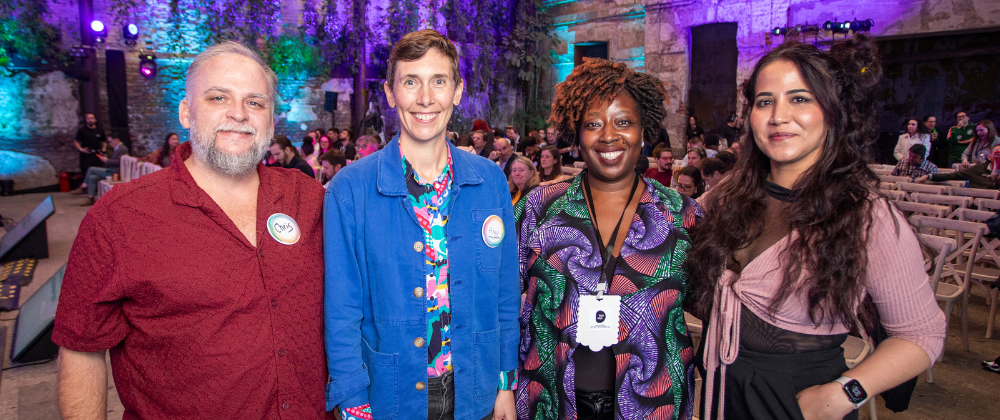
At the closing session of the Interledger Summit 2025 in Mexico City moderated by the Interledger Foundation’s Chris Lawrence, three leaders in public interest technology challenged philanthropic institutions to fundamentally reimagine how they fund equitable financial systems: not just with capital, but with patience, accountability, and community trust.
The Data Dilemma
Amy Sample Ward, CEO of NTEN, a global organization supporting equitable technology use in social impact work, opened with an observation that had haunted them throughout the Summit: nearly every conversation about Open Payments overlooked the critical question of data. “What’s going to happen to my data?” they asked rhetorically, saying it is the first question that arises in digital literacy classes serving communities without reliable internet access.
The fear is rational and well-founded. For formerly incarcerated individuals, creating an online profile feels like wearing a permanent banner advertising their past. For immigrants sending remittances, each transaction raises anxiety: “What am I inadvertently doing to make more vulnerable the person I'm sending money to?”
“There’s so much fear wrapped up in data,” Sample Ward emphasized. “What data is ours? How do we control it? How do we see it? How do we move it? And how do we protect it?”
Afua Bruce, who leads the advisory firm ANB Advisory Group, reframed the issue starkly: “Caring about people in this era is caring about their data.” She described how financial inclusion technologies increasingly rely on algorithmic rating systems to determine creditworthiness. The critical questions become: What data feeds these algorithms? Who builds them? To whom are they accountable? What biases are embedded, and what checks exist to preserve human dignity?
The Labor Market Laboratory
Wilneida Negrón, who works at the intersection of private capital, philanthropy, and future-of-work issues, provided insights from examining hundreds of fintech products entering labor markets. While some workers appreciate earned wage access apps that address immediate cash flow needs, digital forensics reveals a troubling pattern: hidden fees, third-party data sales to insurance companies, and vendor agreements that lock workers into platforms with minimal transparency.
“Workers are just seeing the usefulness,” Negrón explained. “But when you look at the bones — because these products aren’t coming from open source and public interest fields — they actually create new risks.” Workers get locked out of platforms without explanation, penalized without recourse, and trapped by information asymmetries that exist between themselves and the fintech intermediaries now mediating labor relations.
The problem extends beyond individual apps to entire economic structures. As traditional W-2 employment declines and gig work expands, worker cooperatives are attempting to build alternative platforms for house cleaning, driving, and other services. Yet philanthropy consistently fails to fund these alternatives. “I go to philanthropy all the time,” Negrón reported, “and they don’t have a strategy for that. These worker co-ops don’t seem viable or can't scale, which is really problematic for philanthropy to be speaking like that.”
Decentering Extraction
Sample Ward proposed a radical reorientation: decenter capitalism, surveillance, militarism, and colonialism from technology investment. “I would love to say eliminate, but I’ll just say decenter,” they offered. What replaces these priorities? Three principles: sovereignty, freedom, and safety.
“The internet, any individual tool, any technological system should honor my sovereignty, my freedom and my safety,” Sample Ward argued. Evaluated through this lens, very few existing technologies pass muster. The goal isn’t perfection but prioritization: compete on trustworthiness, prove safety, eliminate borders that separate people from their own money.
“Every border belies the violence of its maintenance,” Sample Ward told the audience, quoting Ayesha Siddiqi, invoking borders not just geographic but financial. “Those charts we’ve seen across the stage? Those are borders. There is violence in the maintenance of those separations.”
From Ideas to Infrastructure
Bruce identified a critical gap in philanthropic strategy: the journey from idea to sustainable business. “Funders could really help with derisking the space,” she explained, “creating the time and giving founders the time and space to actually have conversations with community members, with workers, to say what are your actual needs?”
She described grantees needing comprehensive support beyond funding: business consultants, market testing, convening power to bring together cross-industry expertise, marketing assistance. “How do we take ideas from hackathons and provide wrap-around services, not just funding, to create sustainable organizations?”
Sample Ward built on this critique by challenging the accelerator model itself: “We don’t need funders making more accelerators: idea to Minimum Viable Product in six weeks. Ideas are everywhere. We need funders saying, ‘You’ve tried this five times. You’re so much closer than try one. We’re going to fund you all the way to version eight.’” They pointed to the previous day’s documentary about the People’s Clearinghouse as an example: “It wasn’t ‘look how fast we did this,’ it was deep community building that takes time and space and learning.”
Lessons from Silicon Valley's Failures
Negrón offered insights from Silicon Valley, not as a model to emulate wholesale, but as a cautionary tale with instructive mechanics. Y Combinator, the powerhouse accelerator behind Airbnb and other major companies, provides seed funding as well as access to investor networks, future co-founders, and a closed ecosystem of support. “We do not have that on the public interest side,” she noted. “There is no Y Combinator for people building open source tools.”
More tellingly, she described the $30 billion annual investment in AI agents – chatbots meant to revolutionize work that are instead producing what critics call “AI slop.” The failure stems from insularity: founders didn’t spend time talking to unions, workers, or embracing the complexity of labor markets and social issues. “Even with billion-dollar investments, their products are not that useful,” she observed. An OpenAI co-founder recently admitted that functional AI agents remain ten years away.
The lesson for philanthropy? “Founders in those spaces want to build properly. They want to build responsibly. But there’s pressure to grow.” Philanthropic institutions have unique advantages: they can activate multiple capital types (program-related investments, grants, mission-related investments, recoverable grants, revenue sharing agreements) not merely to build technology but to address contextual issues that make technology actually useful.
Measuring What Matters
When Lawrence asked for advice specific to the Interledger Foundation, Bruce challenged the sector’s default metrics: “Users does not equal usefulness.” She advocated measuring trust, dignity, and true access to resources rather than user counts or transaction volumes.
Sample Ward refined this further: “Trust isn’t necessarily what I would recommend as the metric because it’s the precursor to allow any other metrics to happen. Without trust, we’re not here, but trust doesn’t need to be the thing we measure.” Instead, they advocate measuring confidence and skills development: outcomes only possible when trust exists but that also indicate actual adoption and impact.
They also urged funding “the full conditions under which financial tools are being used: building up commerce in that village, funding digital access and broadband, funding holistically around the conditions that exist.” This approach creates space for unexpected, emergent innovations.
Negrón’s closing advice cut to the core: “Pursue the mission, not the strategy.” In the United States, regulatory frameworks lag 15 years behind technological innovation. “We’re already making another big leap,” she warned. “Technology is already getting ahead of mission and people and democracy and human values. We need to invest as much time and resources on the mission, on the people, on the broader context, so that has an opportunity to not get eaten alive by technology that moves a lot faster.”
Bruce challenged the notion of “unintended consequences” that haunts technology discourse: “The unintended consequences are the same every time with every iteration of technology, we forgot to think about the edge cases, Black and brown people, women, people who were differently abled. We just didn’t consider them. And now there are desperate impacts every single time.” These “aren’t unintended, they’re predictable results” of excluding marginalized voices from design processes.
Building Alternatives
The session concluded with practical recommendations beyond funding strategies. Panelists highlighted indigenous-led efforts, particularly Maori communities in New Zealand, reclaiming data through trusts and ownership structures. Others described litigators seeking philanthropic investment in strategic legal funds for class-action lawsuits addressing data harms to workers, consumers, and children. Most urgently, panelists called for funding locally owned, locally controlled, interoperable open source alternatives to extractive platforms. “There could be an ecosystem of people building these alternatives,” Negrón noted. “Creating a fund to support them, along with the sticks of class action lawsuits and litigation, would be valuable.”
The panel’s final message was that philanthropy must move beyond treating technology as neutral infrastructure requiring only capital investment. Building genuinely inclusive payment systems demands patient capital, holistic community investment, accountability mechanisms, and centering sovereignty, freedom, and safety. Anything less perpetuates the violence embedded in existing financial borders, and betrays the communities these systems claim to serve.



Top comments (1)
This is such an amazing panel, and thank you for summarizing the insights to make these important thoughts and ideas more accessible to a larger audience.
I particularly resonate with Wilneida Negrón's struggles with the worker co-ops' viability & scalability being questioned. I think it goes beyond philanthropy: even though people are always talking about centering affected communities, when affected communities actually start to experiment and innovate based on their needs, it is not often welcomed or encouraged. As they are not following the capitalist and market logics that people are not used to, and do not hold the technical & industrial expertise,...not consider that these are the very systems that alienate them and exclude them.
So many golden takes & reflections in this panel, so inspired by all of you who are involved in this panel and make this panel happen! <3