
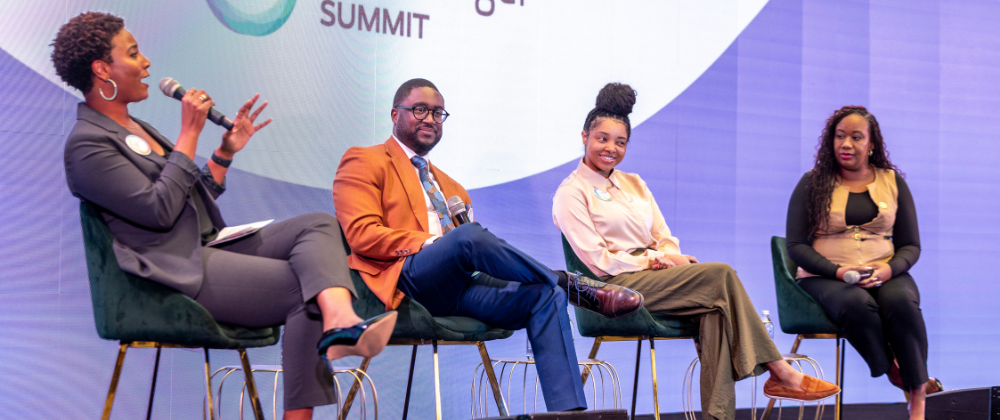

A Session Summary from the Interledger Summit 2025
At the Interledger Summit 2025 in Mexico City, the panel “From Mission to Market: Where Fintech and CDFIs Align and Clash” confronted an urgent paradox in American finance. While 70% of U.S. banks have vanished since 1984, leaving entire communities without traditional financial services, a digital bank and financial technology company called Chime has become the nation's sixth-largest debit card issuer without a single branch. Moderated by Casey Ariel Dike’, the discussion brought together leaders straddling these divergent worlds: Shaundra Jacobs, Texas Market President for CDFI Allcap; Sheena Allen, Interledger ambassador; and Feintz Pierre, VP of Business Development at Lendistry, which operates as both a fintech and a CDFI. Their conversation touched on how fintechs and CDFIs can best serve each other and communities before an unprecedented $84 trillion wealth transfer leaves the traditional banking system entirely.
The Great Wealth Migration Nobody’s Preparing For
Allen laid out the stakes: “You have about 10 trillion, maybe more, of people who are usually baby boomers or up. That’s where their wealth is,” she explained. This wealth, accumulated through 401(k)s, land, and investments, will soon pass to younger generations who have never experienced traditional banking relationships.
The implications are staggering. When Meta recently bought 400 acres in Louisiana for a data center, it likely paid billions to someone’s “great granddad.” But as Allen pointed out, “What’s going to happen when the granddad’s gone and now the grandson or the son has to have it? It’s the first time the son’s gonna be like, what the heck am I gonna do with $2 billion?”
This wealth transfer represents both crisis and opportunity. The crisis: younger generations don’t want bank branches or relationships; 49% of Black investors and 45% of Hispanic investors between the ages of 18 and 34 enter the markets through mobile apps like Robinhood, not investment advisors. The opportunity: whoever bridges the trust of CDFIs with the technology of fintech could capture this massive wealth migration.
Speed Versus Trust: The Fundamental Tension
The panel crystallized the core friction between fintech and CDFIs into stark operational differences. When asked about best-case funding scenarios with perfect documentation, Jacobs reported her fastest CDFI loan took 14 days. Pierre’s fintech platform, leveraging AI and automated verification, could fund a $100,000 loan in nine days.
But these five days represent more than process efficiency; they embody fundamentally different philosophies. “Fintech for the most part, we are very much a ‘we’re going to do it now and ask for permission later,’” Allen explained. “Whereas when you are a CDFI and you are so into the system of the regulatory way, you’re very much like, ‘no, I’m going to ask for permission and then see if I can or cannot do it.’”
This clash extends beyond regulatory appetite to institutional longevity. CDFIs worry about fintech partners disappearing when venture capital dries up. “The CDFIs are like, I don't want to put too much trust and too much time in this relationship and then two months from now, two years from now, I got to start all the way back over somewhere else because you shut down,” Allen observed.
Yet the trust CDFIs provide through “handholding” and technical assistance, which Jacobs calls moving from "ideation stage" through business planning to banking relationships, takes time that entrepreneurs often don’t have. “A lot of times people are already working out of desperation,” Jacobs noted. “They needed the money yesterday.”
The Hidden Strengths of Patient Capital
Lendistry’s dual identity as both fintech and CDFI offers unique insights into each model’s strengths. Pierre emphasized that being a CDFI isn’t just about serving specific underserved markets, but also about delivering financial literacy as a core offering. “After you educate and help these small business owners understand their business model, you take them through the growth cycle and then you start to give them those resources.”
This educational component proves essential because, as Pierre noted, “the data doesn’t always tell the story.” An entrepreneur paying daycare from their business account might look financially undisciplined to an algorithm but could be making rational decisions within their complex reality. “If I missed a payment on something, it could be because my babysitter needed money early or I had to help a family member out,” he explained.
Jacobs reinforced this with her concept of “delay not denial”, which is the CDFI approach of coaching clients toward readiness rather than simply rejecting them. Starting with loans as small as $5,000, CDFIs build entrepreneurs toward “that six-figure ask or that million dollars,” creating generational wealth pathways that quick transactions can’t provide.
The results validate this patience. Bank of America revealed at a recent CDFI conference that over 25 years, they’ve lost only six basis points (less than a tenth of a percent) on their CDFI portfolio. The trust and social capital CDFIs build translates directly into repayment rates that outperform traditional lending.
Technology Without Trust Is Just Faster Rejection
While CDFIs have trust, they desperately lack technology. “My local credit union still doesn’t have a mobile app,” Allen shared, adding with frustration, “I will build you one, please, like let me help you out.” This technology gap becomes critical as younger generations expect digital-first experiences.
The panel agreed that AI and automation show promise for improving backend processes, but warned against removing human elements from customer relationships. “The trust factor usually came from human relationships,” Allen emphasized. “My dad wants to talk to the teller, my dad wants to touch his money.”
Pierre added context about AI’s limitations in serving marginalized communities: “The problem particularly for those in underserved areas, they don’t have the data actually to make the AI work properly.” When financial AI models train primarily on data from major banks serving affluent communities, their outputs become “horrible” for someone in rural Mississippi where those banks don’t exist.
The panel did highlight one success: during the Paycheck Protection Program, 50% of loans to Black businesses came from online banks with no branches, because automated underwriting removed subjective bias that might have excluded these borrowers from traditional channels.
The Banking Extinction Event
When asked whether traditional banks would survive the next 10 to 20 years, the panel offered varying predictions. Allen believes banks will persist by acquiring successful fintechs — “they have enough money to just keep acquiring” — and expressed concern for community institutions: “I’m scared that credit unions will disappear... the same way we have seen Black banks and Minority Depository Institutions start to disappear.”
Dike’ invoked Bill Gates’ 1994 observation that “banking is necessary, banks are not.” She predicted that non-financial companies would unseat traditional banks for marginalized communities, citing Kenya’s Safaricom, whose mobile money network now processes 60% of the country’s GDP outside the banking system. With AWS already developing “agentic models” for AI-to-AI financial transactions, the disruption might come from technology companies rather than financial institutions.
Building New, Rather Than Fixing Broken
The panel’s closing advice for next-generation leaders was unanimous: stop trying to fix a broken system. “We keep trying to just make adjustments to a system that’s already broken,” Allen argued. “Because fintech can move fast, because CDFIs are way more in tune with the community, we have a much better opportunity to just build something new.”
Jacobs added an emotional dimension often missing from financial innovation discussions: “When it comes to my money, I have a lot of feelings about that... I am trying to really do generational wealth for my family and my livelihood.” This human element — feelings about money, dreams of generational wealth, the need to be seen as more than a number — must inform any successful collaboration.
Dike’ concluded with a challenge to recognize “when marginalization is a feature of the system and not a failure of it and decide what you’re going to do about it.”



Top comments (0)