
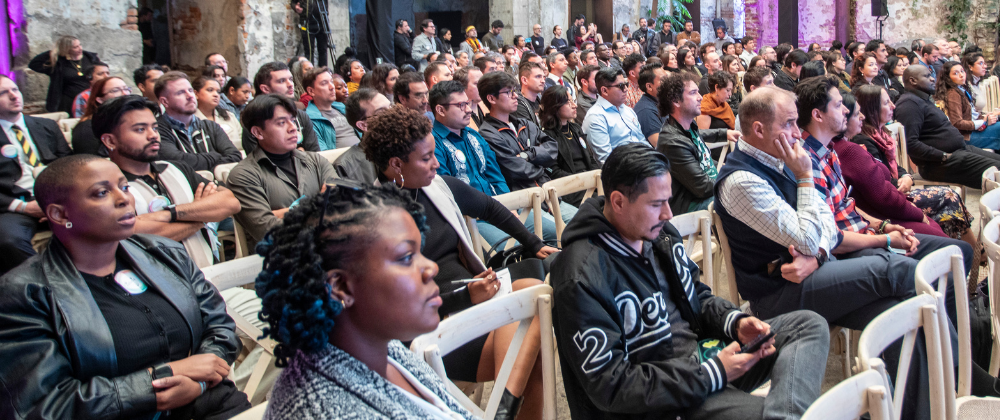

At the Interledger Summit 2025 in Mexico City on November 5-6, eight Listening Lab sessions converged around four critical themes that challenge conventional approaches to digital financial inclusion. The subject matter experts and practitioners present argued that achieving genuine financial equity requires rethinking our fundamental assumptions about technology, power, and community agency.
Theme 1: Technology as Political Architecture
Two sessions explored how digital financial systems encode political decisions that shape economic participation globally. “Human Rights by Design: Financial Infrastructure that Works for Everyone” introduced the concept of “algorithmic intensification,” arguing that digitization amplifies existing inequalities unless deliberately designed otherwise. Panelists showed how payment systems embed choices about who can participate, what behavior appears suspicious, and whose money flows freely. These decisions, coded in one country, immediately affect people elsewhere.
“Trustworthy by Default: Designing Digital Finance People Choose to Use” grounded these concerns in Mexican reality. Despite 400 regulated financial institutions and three decades of instant payments, consumer trust remains fragile. Nearly half of all complaints stem from unrecognized transactions, while opacity breeds confusion even among sophisticated users. Together, these sessions established that building trust requires transparency, proximity, and user control.
Theme 2: Reimagining Capital and Support Systems
The next cluster examined how funding and support structures must evolve. “Rights and Rails: How Philanthropy Links Access, Capacity & Inclusive Payment Systems” challenged philanthropic institutions to provide patient capital and wraparound services rather than chasing scale. Panelists stated that Silicon Valley wastes billions on solutions built without community input, while philanthropy too often dismisses community alternatives as “unviable.” They advocated measuring dignity and trust rather than user counts.
“From Mission to Market: Where Fintech and CDFIs Align and Clash” explored the tension between speed and relationship building in lending. While fintechs fund loans in nine days versus CDFIs’ typical turnaround time of 14 days, those extra five days represent trust building that is essential for generational wealth creation. With $84 trillion in wealth about to transfer between generations in the U.S., the panel warned that young people entering markets through mobile money apps lack the financial literacy that personal relationships traditionally provided. Both sessions argued for supporting community-controlled alternatives rather than extending corporate services.
Theme 3: Regional Insights with Global Implications
Three regional panels revealed how Latin America serves as both a cautionary tale and innovation laboratory. “Unlocking Financial Interoperability in Latin America” showed that technical infrastructure means little without aligned incentives. Mexico has superior payment rails to Colombia but worse inclusion because stakeholders view each other as competitors rather than collaborating against cash, which still dominates 85% of transactions.
“From Access to Wellbeing: Designing Financial Tools Women Can Trust and Use” confronted the widening gender gap in financial inclusion across Latin America. Even highly educated women choose less profitable investments due to mistrust, while products designed for formal sector workers ignore women juggling caregiving with informal employment. The panel called for recognizing and strengthening existing practices like rotating savings groups rather than displacing them.
“From Policy to Practice: Financial Inclusion in Mexico” showcased radical experiments in community ownership. Indigenous telecommunications cooperatives break extraction cycles by keeping resources local, while community investment platforms enable neighbors to fund local businesses. These models demonstrate that communities can build and operate their own infrastructure rather than waiting for corporate or government provision.
Theme 4: Cultivating New Talent
“From Classroom to Codebase: How Universities Cultivate the Next Generation of Open Payments Talent” offered hope through educational innovation. Programs funded by the Interledger Foundation at Bowie State University, University of Cape Town, and The Hague University of Applied Sciences show that students from historically excluded communities bring essential insights. Their lived experience of financial exclusion, when channeled through appropriate curriculum, produces solutions that surprise seasoned practitioners. The session emphasized that preparing ethical technologists requires understanding community needs, not just mastering code.
The Path Forward
Across all eight sessions, practitioners delivered a consistent message: financial inclusion fails when systems are extended to communities rather than owned by them. The discussions surfaced that every technical choice embeds values, that trust must be earned through transparency and proximity, and that meaningful inclusion requires patient capital, inclusive governance, and recognition that communities already possess sophisticated financial practices. These insights matter urgently. As financial infrastructure increasingly mediates economic life globally, the design choices made today determine not just who can access services, but who controls the architecture of economic participation itself.



Top comments (0)